

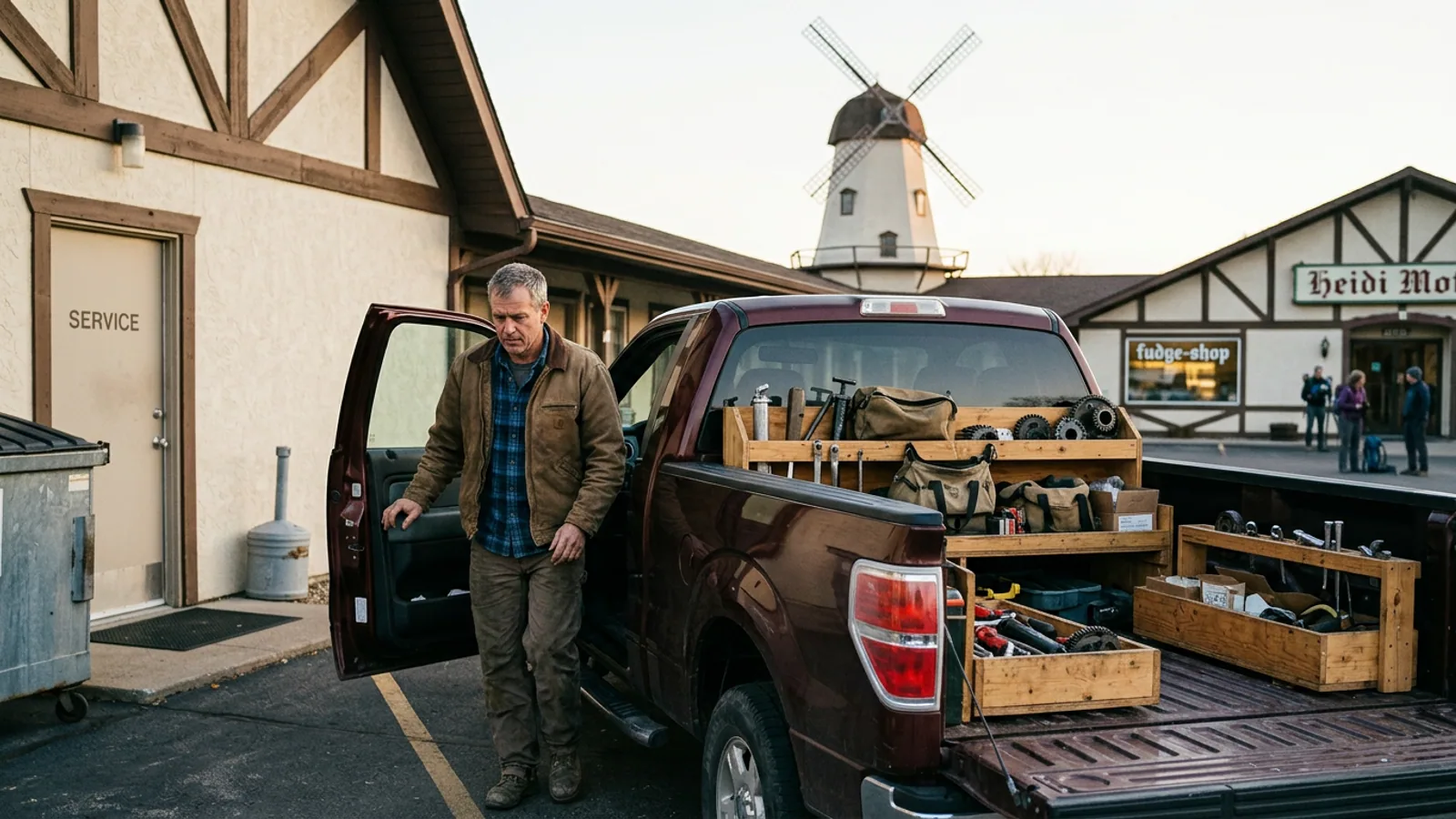
Rolf Kessler arrives at the Heidi Motel's service entrance at 7:30 a.m. on the first Tuesday of every month. He parks his truck — a 2009 Ford F-150 with a set of wooden tool-trays in the bed that he built himself and that he refers to, collectively, as "the cabinet" — and he carries his tools to the courtyard in two trips. Brunhilde Maurer, his co-worker of 22 years, arrives seven minutes later in a separate vehicle. She carries the lubricant kit. He carries everything else.
They have been maintaining the Heidi Motel's windmill since 2003.
"We don't talk much when we work," Rolf told me, approximately 20 minutes into the first of two sessions I spent with them on a Tuesday morning in early March. He was not being unfriendly. He was observing a professional fact, delivering it with the equanimity of a person who has made peace with all the facts of his profession.
I had asked if I could watch.
"You can watch," he said. "Don't touch the main hub when we're running the rotation test."
I did not touch the main hub.
The Heidi Motel's windmill is, as the motel's own informational materials cheerfully acknowledge, entirely ornamental. It does not pump water, generate electricity, or perform any mechanical function beyond the function of being a windmill — which is to say, it rotates in a breeze, it creates the visual impression of a functional windmill, and it contributes to the Bavarian-Alpine themed environment that the Heidi Motel has been maintaining in the center of Helen, Georgia, since the property's original construction.
That it is ornamental does not mean that its maintenance is simple.
"People think ornamental means fake," Brunhilde said, around 9:15, during a brief pause while Rolf reset the tension on the main coupling. She was addressing this to no one in particular but was, I believed, aware that I was taking notes. "Fake things don't have bearings. Fake things don't have a cap that takes wind load."
She said this with the cadence of a person who has made this observation before and has not found it necessary to add to it.
The windmill has 11 moving parts. Rolf enumerated them for me on my request, in order of their complexity: the four blades (each one a moving part in the sense that it can be removed and replaced, and each one carrying its own weight-balancing requirement); the main hub (the central axis from which the blades extend, containing the primary bearing and the rotation collar); the tail fin (which orients the blades into the wind and which carries, Rolf explained, more load per square inch than any other component when a strong wind comes off the Nantahala); the tail vane linkage (a two-piece articulating mechanism that connects the fin to the hub and allows the head to rotate on its vertical axis); the main drive shaft (ornamental in function — it connects to nothing — but structural in form, carrying the full weight of the blade assembly); and the cap brake (a friction device at the top of the tower that slows the blade rotation in high wind, installed after an incident in 2011 that Rolf described only as "a wind event we did not want to repeat").
I asked about the 2011 wind event.
"The Nantahala," he said, which functioned as a complete answer.
The maintenance protocol Rolf and Brunhilde follow was developed, as best Rolf can reconstruct it, by the previous maintenance crew who held the contract before them — a pair of brothers from Robertstown whose last name Rolf knew but did not volunteer — and has been modified over the 22 years of their tenure at a rate Rolf estimates at "maybe one thing per year." The most recent modification was the addition of a secondary bearing inspection at the tail vane linkage, added in 2023 after a linkage failure at another ornamental windmill property in the region (Rolf did not name the property; I did not press).
The protocol runs as follows: the crew arrives at 7:30. Rolf sets up the scaffolding — a two-section aluminum frame that reaches the hub without requiring a full extension ladder — while Brunhilde opens the lubrication kit and prepares the injection wand. The first stage is visual: both Rolf and Brunhilde walk the full circumference of the windmill at ground level, looking for any sign of blade wear, tower corrosion, or cap deformation that would require immediate attention. They have, in 22 years, found conditions requiring immediate attention on four occasions, all of which Rolf catalogued in a notebook that he keeps in the glove compartment of the F-150.
"Two of them were weather," he said. "One was a bird's nest inside the hub. One was vandalism."
I asked about the vandalism.
"Someone tried to climb the tower," he said. "The scaffolding helps. They used the scaffolding."
He did not volunteer further detail. I did not ask.
After the visual inspection, Brunhilde climbs the scaffolding to the hub. This has always been her job. When I asked Rolf whether the division had been established explicitly at the outset of the contract or had evolved naturally, he considered the question with a seriousness it probably did not require and then said: "She asked to climb it. The first time we worked together, she just went up. I didn't climb it. I haven't climbed it."
Brunhilde, from the hub platform, did not add to this account. She was, at the moment I asked, injecting lubricant into the main bearing collar with the focused attention of a surgical technician. The wand made a specific pneumatic sound at each injection point — a soft hiss, followed by a brief silence, followed by Brunhilde's quiet confirmation that the point had taken. She performed this operation at seven distinct points on the hub, in an order that she has not varied in, she later told me, at least a decade.
"If you change the order, you have to think about the order," she said. "If you don't change the order, you can just do it."
This is, I want to say, a philosophy of craft that I found unexpectedly moving. It is the philosophy of the person who has performed a specialized task long enough to achieve, through repetition, a kind of freedom from the task — who has, in the phenomenological sense, dissolved the boundary between the doing and the not-doing.
I am aware this is a great deal of intellectual freight to load onto a lubricant injection sequence. I am loading it anyway.
The rotation test is the part I had been told not to interfere with, and understanding why requires understanding what it involves. Once Brunhilde has completed the hub lubrication and Rolf has addressed whatever minor structural issues the visual inspection identified, the two of them disengage the cap brake and allow the blades to run free for a measured interval — standardly 12 minutes, extended to 18 if the weather the previous month has been particularly wet. During the free-run, they observe the blade rotation from opposing positions: Rolf from the north, Brunhilde from the south. They are looking for any wobble in the rotation plane, any acoustic irregularity (a blade with a developing crack produces a sound, at speed, that Rolf described as "not exactly a whistle but in the direction of a whistle"), and any evidence of asymmetric wear on the hub collar.
They do this without speaking. I watched from a distance of approximately 12 feet, which Rolf had indicated was an acceptable observation distance.
The blades turned. The morning was quiet. Brunhilde had her arms folded. Rolf had his hands in his jacket pockets. The hotel's guests, in the rooms above the courtyard, were apparently still asleep; no windows opened, no curtains moved. The windmill turned in a northeast wind at a cadence I had spent considerable time analyzing from within those same rooms and now understood, for the first time, not as surveillance but as maintenance — as the product of two people who show up on the first Tuesday of every month and do the same thing they have always done.
The 12 minutes concluded. Rolf checked his watch. Brunhilde re-engaged the brake from the scaffold platform, performing, on the brake mechanism, a final inspection that she described later as "making sure it's itself."
"Making sure it's itself" is not a technical formulation. It is the description of a person who has looked at the same mechanism often enough that she has internalized its correct state and can perceive, by direct observation, any deviation from it. This is what mastery looks like when it is not performing itself. This is what 22 years of showing up produces.
By 10:15, the tools were back in the cabinet and the scaffolding was broken down and loaded into the truck bed. Brunhilde was completing a handwritten entry in the maintenance log — a carbonless three-copy form that she fills out by hand at the end of every visit, of which one copy goes to the motel's front desk, one copy goes to Rolf, and one copy Brunhilde keeps in a binder in her own vehicle that she showed me briefly and that contains, in chronological order, every maintenance record going back to the first month of the contract in November 2003.
The first record, at the top of the first page of the binder, is dated November 4, 2003. It reads, in handwriting that is younger and slightly less assured than the handwriting I watched her use this morning: Blades and hub — standard check. New contract. No issues found.
"We had a different form then," she said, closing the binder. "That one was just for notes."
I asked if the windmill had been different then.
"It was the same windmill," she said. "We were different."
I walked back through the lobby on my way out. The carpet had its Tuesday smell. The windmill was visible through the lobby window, blades moving in the wind from the north, patient as it has always been, as it will be on the first Tuesday of next month when Rolf parks the F-150 in the service lot and Brunhilde arrives seven minutes later with the lubrication kit.
The windmill does not know it is maintained. It turns because the wind turns it and because, once a month, two people climb a scaffold and ensure that it can continue to do so. This is, in a way that I have been attempting to articulate since I left the courtyard, the most Helen thing about Helen: the elaborate, devoted care extended to something that is, by design, only what it appears to be.
The windmill is ornamental. Its maintenance is not.
— Kaitlyn Reese-Brockman


Reader Comments
Leave a comment ↓