

I want to say, before I describe what happened, that I went into this in good faith.
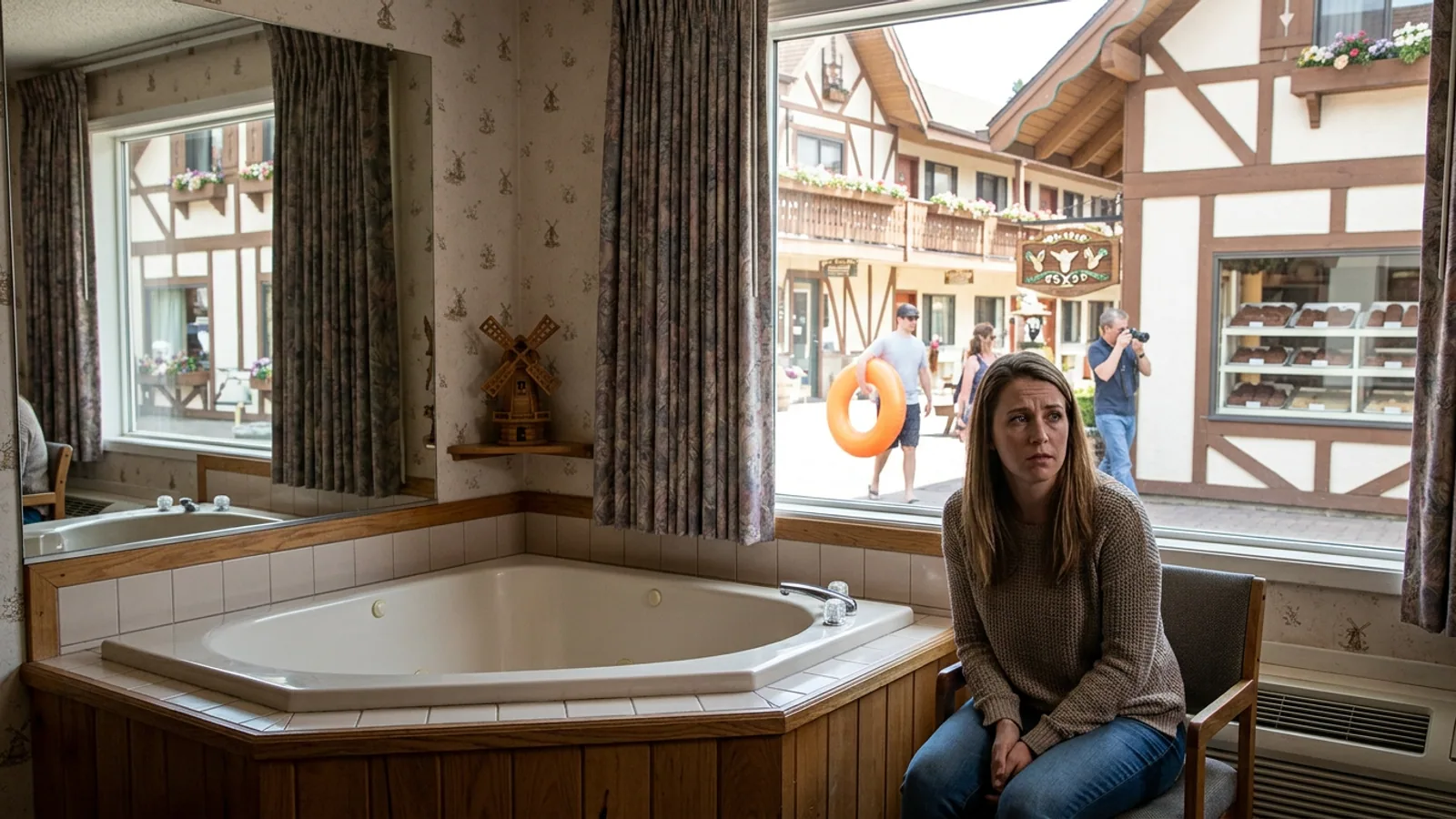
I had booked, through the Heidi Motel's website, one of the property's second-floor Windmill Suites — a room category that the hotel's marketing language describes as offering "the in-room hot tub experience Helen's most distinctive lodging property is known for." I had booked it because I had been in Helen for ten days, because I had been writing about hotel lobbies and put-in queues and the social grammar of the float, and because I wanted, for one evening, to be in hot water instead of cold.
The room is as described. The hot tub occupies the alcove between the sleeping area and the window that faces the courtyard. It is a standard two-person acrylic jetted unit, white, with a chrome toggle for the jets and a small laminated card affixed to the inner ledge recommending a maximum soak time of 20 minutes for cardiovascular reasons. The carpet smells, on a Tuesday evening at 9:30 p.m., of a cleaning product that is trying sincerely to smell like nothing and is not entirely failing. The bed is firm. The television is large.
None of this was unexpected. What I had not adequately prepared for was the windmill.
The Heidi Motel's windmill is ornamental — which is to say, it exists not to pump water or generate power but to be a windmill in the visual field of a motel that is, in its totality, a themed environment. It stands in the center of the courtyard, approximately 34 feet from the exterior face of the building, and rises to a height that the motel's informational card, which I found in the nightstand drawer alongside the room-service menu and a brochure for the Sautee Nacoochee Cultural Center, describes as "over three stories." The blades rotate in a breeze. At night, with a moderate wind coming down from the Nantahala, they rotate with a specific rhythm — not mechanical, not exactly natural — that I spent some time trying to characterize before settling on the word patient.
The problem, which I did not identify until I was in the hot tub, is the sight lines.
I should have studied the geometry before I filled the tub. But I had not. What I discovered, approximately seven minutes into the soak, was that the second-floor window — which I had drawn the curtain across before disrobing but which, as I then realized, I had not fully closed — was positioned at precisely the right height and angle to allow the uppermost two blades of the windmill to be visible from within the tub. The blades, moving at their patient rhythm, crossed the window's vertical gap at intervals of approximately eight seconds.
Each time a blade crossed the gap, it occluded, briefly, the parking-lot light that had been providing my ambient illumination.
The room went briefly darker. Then lighter. Then darker.
For the first ten minutes I considered this merely a fact of the room. Then something shifted in the quality of my attention.
Susan Sontag, in On Photography, describes a particular kind of visual anxiety that she associates with being photographed by a camera one has not noticed: the sense not merely of being seen but of being documented — of one's present state of being converted into a record that will persist after the moment has ended. This is, she argues, a specifically modern anxiety, one that the camera introduced into consciousness. Before the camera, one could be observed without being archived. After the camera, the two acts became inseparable in the imagination.
I am not arguing that the windmill was a camera. I am arguing that the windmill produced, in me, a functionally identical response.
The blade crossed the window gap. The room went briefly darker. My body, in the water, was a thing that could be perceived from the courtyard — if anyone happened to be looking from the courtyard at the upper-right corner of the second-floor wing, through the two-inch gap in the curtain, at the precise moment when the parking-lot light was blocked by the passing blade and my position in the tub was illuminated instead by the glow of the bathroom fixture I had left on.
Nobody was in the courtyard. It was a Tuesday evening in February. I had passed through the courtyard on my way to the room and it had contained no one and nothing except the windmill, a dormant potted shrub of the rhododendron type, and a small wrought-iron table whose two chairs were stacked against it for the season.
The courtyard was empty. The windmill was not watching me.
I know this.
What I want to call the anxiety — though perhaps disturbance is more accurate, or Barthes's own preferred term unease, the one he uses in Camera Lucida to describe the photograph that refuses to release the viewer's attention — is not about voyeurism in any literal sense. It is about the architectural fact that the hot tub's position within the room, and the room's position within the building, and the building's position relative to the windmill, create a spatial configuration in which the categories of private and observed are imperfectly separated.
The suite is designed to offer the privacy of a personal hot tub. The suite is also positioned with its window facing an exterior feature — the windmill — that is by design a focal point of the property. These two design intentions are not, in principle, contradictory. But they coexist in the room at a distance of approximately 34 feet, and the window gap makes the coexistence imperfect.
I spent twenty minutes on this analysis before I realized I had been in the hot tub for over an hour.
The windmill, I have since learned, has 11 moving parts, a fact I obtained from the maintenance crew whose work on the structure I later observed and whose account of the windmill's mechanical life I found unexpectedly moving. (That is a separate piece.) For the purposes of this essay, the relevant number is not 11 but 34: the 34 feet between the outer wall of the second-floor suite and the nearest blade's arc.
At 34 feet, under moderate February wind, the blades move through the window gap at a cadence that I eventually measured, using the clock function on my phone, at 7.3 seconds per blade crossing. Over 90 minutes, that is approximately 740 crossings. The room went briefly darker 740 times.
I did not, ultimately, experience the hot tub as relaxing. I experienced it as a sustained exercise in the specific kind of attention that the traveler brings to a place when the place offers more to look at than she had anticipated. This is, I want to say, not a complaint. It is an observation. The Heidi Motel's Windmill Suite produced in me a quality of presence — a sharpening of attention to the room, the water, the light, the seven-second interval — that I have not encountered in more straightforwardly anonymous lodging.
There is something in Barthes's concept of the studium — the general, educated interest in a photograph, as opposed to the punctum, the detail that pierces — that maps onto the difference between the ordinary hotel experience and the Heidi Motel hot-tub experience. The ordinary hotel room offers a studium: the generic forms of comfort and rest, the recognizable patterns of the hospitality industry, the room that is efficiently adequate to the purpose of sleeping in it. The Windmill Suite offers a punctum: the specific, unrepeatable fact of the windmill at 34 feet, the eight-second rhythm, the curtain gap.
The traveler cannot unsee the punctum once she has found it.
I turned off the jets at 11:23 p.m. The room, without them, was quiet in a way that felt earned. I could hear, faintly, the Chattahoochee from somewhere behind the building — not the river itself, probably, but the specific acoustic artifact that moving water produces when it reflects off a parking structure. The windmill was still rotating. I could not see it with the lights off; I could hear only the faint rotation of the blades, patient as they had been at the beginning, unchanged by my extended observation of them.
I got into bed at 11:41. I thought about the room's geometry for another 20 minutes before I went to sleep.
A note on the carpet: it smells, on a Tuesday evening in February, of a cleaning product that is trying to smell like nothing. By Wednesday morning it has shifted, subtly, toward something that is not quite pine and not quite laundry but is specific to this room, in this motel, at this hour. I have not been able to identify the compound. I believe it is not commercially produced but is instead the accumulated olfactory residue of the room's particular history — the guests who have soaked in the tub, the cleaning staff who have addressed the carpet, the windmill that has rotated, indifferently, through all of it.
The Heidi Motel's lobby carpet smells similarly on a Tuesday afternoon. I noted this on my first visit, in a sentence in my notebook that I did not expect to become relevant to anything. It has become relevant to something.
The specific way the Heidi Motel smells on a Tuesday is, I want to argue, part of what makes it the most interesting single property in a hundred miles. The smell is not the smell of a themed environment trying to smell like Bavaria. It is the smell of a place that has been consistently itself for long enough to develop an olfactory signature. This is, in hospitality terms, rarer than it sounds.
I will stay in the Windmill Suite again. I will close the curtain fully next time, and I will see if the room is different when the windmill cannot reach it.
I suspect it will be.
— Kaitlyn Reese-Brockman


Reader Comments
Leave a comment ↓