

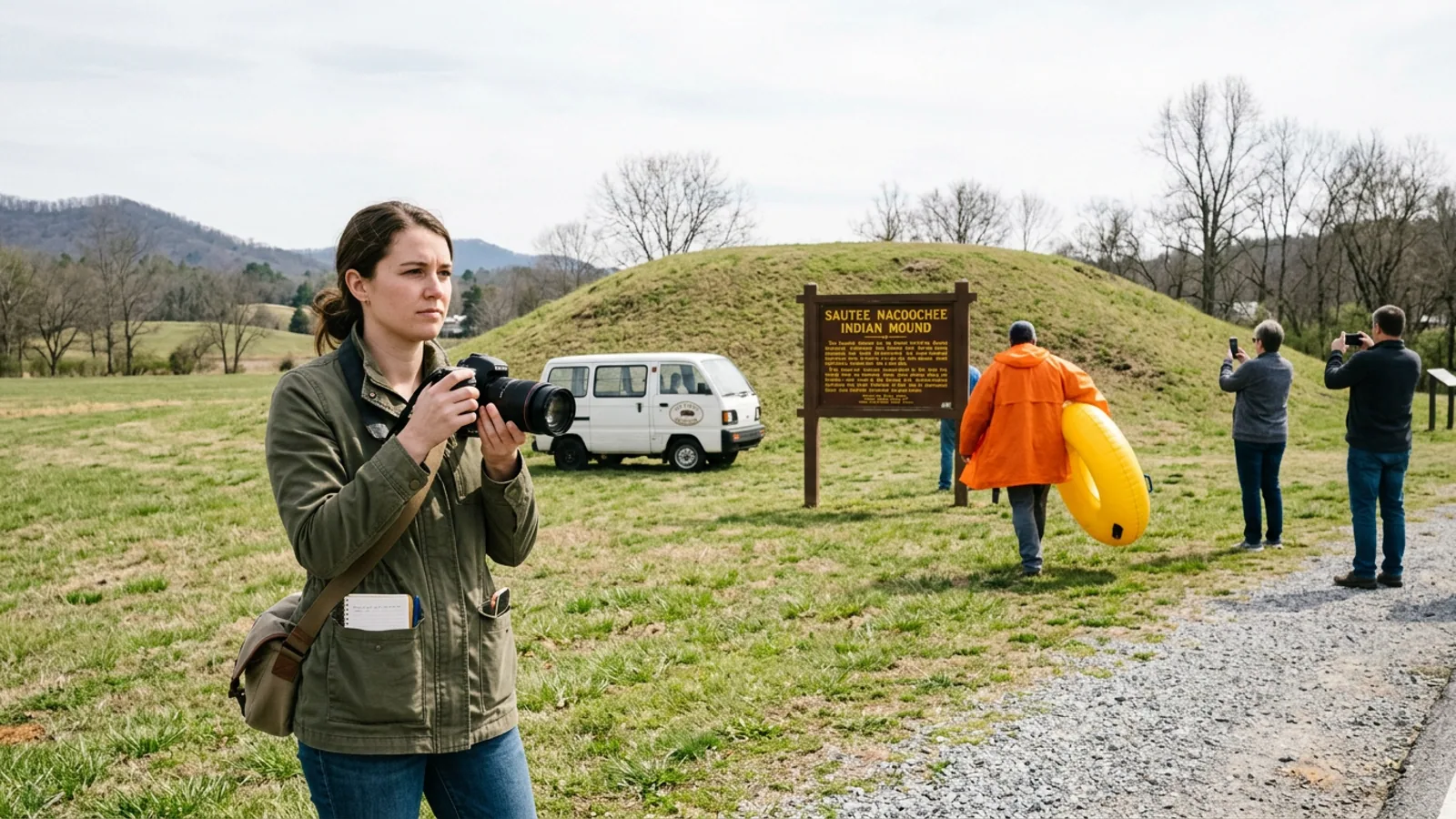
The mound is not large.
This is the first thing I wrote in my notebook when I arrived at the Sautee Nacoochee Valley on a Monday morning in early March and stood at the shoulder of State Route 17 looking at the thing that had, in the summer of 2024, become a minor but consequential incident in the ongoing national conversation about the relationship between social media, recreational behavior, and places that are not recreational. The mound rises approximately 20 feet from the valley floor. It is covered in grass. It has a small Victorian gazebo at its crest, installed sometime in the late 19th century, which sits there with the irreversibility of a historical mistake that has become, through the passage of time, a historical fact.
The mound is not large, but it is old. The Georgia Historic Preservation Division's site documentation dates its construction to the Woodland period, approximately 100 to 900 CE. The people who built it used it, over multiple generations, as a burial site. Beneath the grass and the gazebo and the 20 feet of earthen elevation are human remains, which is a fact that the landscape does not announce and which the TikTok video did not mention.
The video was posted in July 2024 by a visitor — identified in subsequent coverage only as a man in his mid-20s from the Atlanta metro area — who filmed himself running a short distance and then dropping into a prone position and rolling down the mound's west face. The video was 23 seconds long. At the time of my visit, the original post had been removed, but archived copies were still findable by anyone who looked; in total, the content had generated approximately 4.1 million views across the platforms on which it was reposted before the original was taken down. A second account posted it with the caption "Helen Georgia's secret hill." It received 870,000 additional views before that copy was also removed.
"Secret hill" is doing considerable work in that caption.
The mound is listed on the National Register of Historic Places. It is identified in Georgia's Historic Preservation Division catalog under site number 9WH1. The state erected an interpretive marker at its base that has stood there, in various iterations, since at least the 1960s. It is, in the most precise and unambiguous sense available, not a secret hill. It is a documented burial site that is visible from a state highway and that the Sautee Nacoochee Cultural Center — located in the valley and staffed by people who have dedicated their professional lives to exactly the kind of public education that might prevent a 23-second video — had been working to contextualize for visitors for decades before the video was made.
I visited the Cultural Center on my first morning and spent two hours with its educational materials. I want to be careful here, because one of the disciplines that a week at Sautee Nacoochee produces in an outside observer is a discipline of care — a studied attention to the difference between what one knows and what one is inferring, between what the documentary record supports and what the imagination supplies.
What the documentary record supports: the Eastern Band of Cherokee Indians issued a formal statement in August 2024 responding to the mound-rolling video and to subsequent imitative videos that had, in the weeks following the original's circulation, produced at least three additional instances of visitors treating the mound as a recreational feature. The statement called on visitors, platform operators, and regional tourism authorities to recognize the mound as what it is: a burial site, a place of cultural and spiritual significance to Indigenous communities, and a National Register property protected under federal law. It called for better visitor education, improved physical deterrents at the mound's base, and a review of the State Route 17 interpretive marker's visibility and content.
I will not invent quotes from any named individual or organization. What I will say is that the statement was measured, direct, and entirely specific about the harm that had been done — not only by the original video but by the imitative videos that followed and by the comment sections that had, in some cases, treated the mound's sacredness as a punchline.
By the time of my visit, the post-and-cable perimeter had been installed at the mound's base: four-inch treated posts at approximately ten-foot intervals, connected by a single cable at a height of roughly 30 inches. The installation is modest. It is not designed to make the mound inaccessible to a determined person; it is designed to make the mound's boundaries legible, to produce a physical signal that the thing inside the perimeter is different from the parking area and the meadow outside it.
The new interpretive panel, mounted on a steel post at the perimeter's north-facing entrance, is larger than the previous marker and better lit. It describes the mound's age, its use, and its significance. It uses the word "burial" in the first sentence, which the previous marker had not done.
I stood at the panel for a long time. A family with two children passed me and the father read the panel aloud, more slowly than I would have expected. The children looked at the mound. One of them, the younger one, asked if the people were still there.
"Yes," the father said. He did not elaborate.
I thought about what it would mean to elaborate. I thought about the 23-second video. I thought about the 4.1 million views. I thought about the difference between a secret hill and a burial site and whether 4.1 million people had been genuinely unaware of the distinction or had known it and had not cared or had known it and had not known how to translate that knowledge into the behavior of not posting a 23-second video.
I could not determine which of these was true, and I recognized that the uncertainty itself was part of the thing I had come here to understand.
The imitative videos did not stop entirely with the installation of the perimeter. I spent two evenings during my week in the valley searching current social media for content tagged with the mound's location, and I found, in that search, two additional videos posted in the months after the perimeter's installation. In both cases, the creators had stopped at the cable rather than crossing it. In both cases, the videos were, by the standards of the genre that the original had briefly established, anti-climactic: a person walking toward the mound, encountering the cable, pausing, looking at the interpretive panel, and saying something to the camera.
In one of these videos, the creator read the first sentence of the interpretive panel aloud. Then they turned the camera toward the gazebo at the mound's crest, held it there for a moment, and ended the video.
It had 13,000 views. None of the comments called it a secret hill.
I want to say something about the Sautee Nacoochee Cultural Center, which is the institution that has been attempting, with the resources available to a small regional organization, to do the work of public education in a media environment that systematically rewards content that does not do this work. The Center maintains archives. It hosts school groups. It produced the interpretive materials that are now installed at the mound. It has, in its public communications, consistently chosen a register of seriousness over a register of outrage, which is, I suspect, both an ethical choice and a pragmatic one — the recognition that the audience the Center is trying to reach is not reached by outrage but might be reached by clear, patient description.
I am not sure the Center's strategy is working at the scale the problem requires. I am sure that the alternative strategies available to a small regional cultural organization with limited resources are not obviously better. What the Center is doing — showing up, explaining the thing, installing the sign, making the panel legible — is not nothing. It is, in fact, the same thing that a maintenance crew does when it arrives at an ornamental windmill on the first Tuesday of every month. It is the work of people who understand that things do not maintain themselves, that meaning does not preserve itself, that the difference between a burial site and a secret hill is a distinction that must be continuously made.
On my last morning in the valley, I arrived at the mound at 7:15 a.m., before the tourist traffic had started. The valley was very quiet. The mound's grass was still wet with dew. The gazebo at the crest sat in the early light exactly as it has sat, I suppose, for the 150 or so years it has occupied that position on top of something vastly older.
The mound is not large. It is, at 20 feet, a modest elevation in a valley full of mountains. From the shoulder of Route 17 it is easy to miss if one is looking at the Chattahoochee hills behind it. From the parking area immediately adjacent, it is present and specific and clearly itself.
I stood at the perimeter for a while. I read the new panel again. I thought about the 4.1 million views and the 13,000 views and the father reading the panel to his children and the child asking if the people were still there.
They are still there.
The panel says so in the first sentence.
— Kaitlyn Reese-Brockman
Reader Comments
Leave a comment ↓