


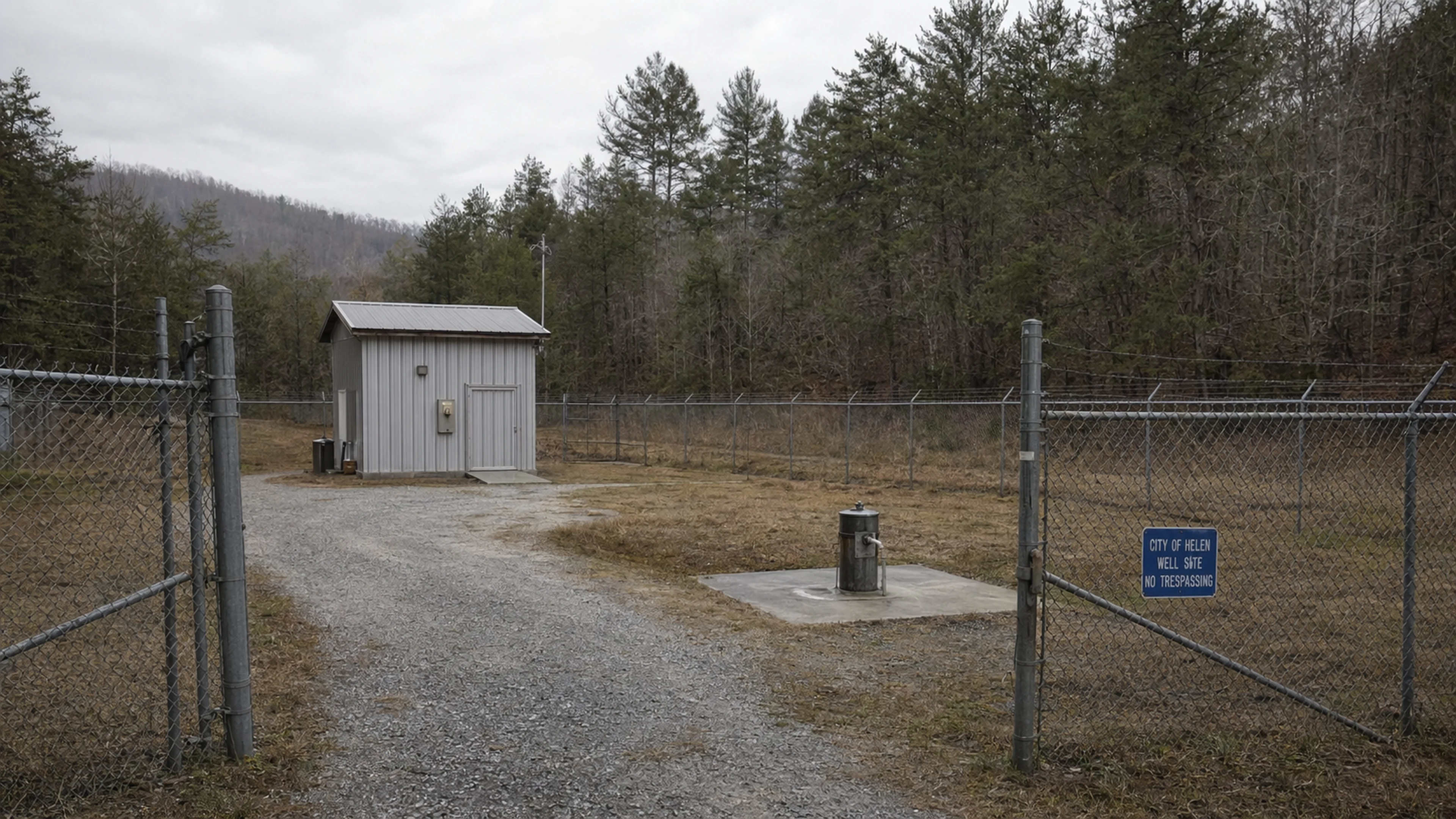
On April 16, 2026, at 10:00 a.m., two sealed bids were opened at Helen City Hall, 25 Alpenrosen Strasse, for the replacement of one groundwater monitoring well. The first envelope contained a proposal from Sailors Engineering Associates, Inc., of Lawrenceville, Georgia, in the amount of $6,611.00. The second contained a proposal from Nutter and Associates, Inc., of Athens, Georgia, in the amount of $20,930.00. The spread between the low bid and the high bid was $14,319.00, or approximately 216 percent.
The scope of work, as defined by the engineering letter report prepared by Wiley S. Helm, P.E., of Engineering Management, Inc. — reachable at [email protected] — called for the installation of a single four-inch monitoring well, per-linear-foot pricing for additional depth beyond the base specification, and the abandonment of the existing well in accordance with Georgia Environmental Protection Division protocols. The plans and engineering letter report had already been approved by EPD prior to the bid opening. The project is not large. It is one well.
A 216-percent spread on a single-scope public procurement between two qualified bidders is the kind of variance that, in a federal contracting environment governed by FAR Part 15.404-1, would trigger a mandatory cost-analysis review and, in most cases, a written determination by the contracting officer explaining why the low bid was not itself evidence of a deficient understanding of the scope. At the municipal level in Georgia, a spread of this magnitude is noted in the bid tabulation, reported at the next Commission meeting, and entered into the minutes prepared by City Clerk Marilyn M. Chastain, who signs each set of minutes with the words "Respectfully Prepared."
Dr. Wilhelm Brüning, a procurement theorist formerly of the Bavarian State Institute for Regional Cultural Geography and a longtime observer of Helen's municipal operations, said the 216-percent figure "is not, by itself, diagnostic of anything except that two firms looked at the same hole in the ground and arrived at numbers separated by more than the annual beer-and-wine excise revenue for the month of March." Helen's beer, wine, and liquor excise collections for March 2026 totaled $12,294, according to the city's monthly financial report — placing the bid spread at 116.5 percent of one month's alcohol tax intake, a comparison Dr. Brüning called "illustrative but not dispositive."
The question of why two bidders can examine an identical scope document and produce estimates separated by a factor of 3.16 has at least three plausible explanations, none of which are mutually exclusive. The first is overhead structure: Sailors Engineering Associates, headquartered in Lawrenceville, may operate a drill rig fleet with lower mobilization costs to the Helen area than Nutter and Associates, based 92 miles away in Athens. The second is opportunity cost. A firm with a full project backlog may price a small municipal job at a premium sufficient to justify pulling a crew off higher-margin commercial work. The third explanation, noted by a procurement specialist who declined to be named, is that one bid may function as an "anchor bid" — a price submitted not with the expectation of winning but to establish, for future reference, that the winning bidder came in "below market." This practice is not illegal under Georgia law. It is also not provable from a bid tabulation alone.
216% Spread Between Two Qualified Bidders
"The bid tab is a photograph," the specialist said. "It tells you what two firms wrote on two pieces of paper on one morning. It does not tell you what either firm ate for breakfast, or whether the estimator at Nutter ran the numbers during the drive up from Athens, which is what the spread suggests if you are feeling uncharitable."
Helen has encountered bid-spread irregularities before. The LAS Spray Field Vegetation Improvements project, put out for bid in the fall of 2025, drew a single response that came in "considerably above estimate," according to discussion at the December 16, 2025 Commission meeting. That bid was rejected and the project slated for rebid — a process that, as of the April 21, 2026 agenda, remained listed under the status heading "on hold." The monitoring well replacement, by contrast, produced two bids, both responsive, and a spread that made the spray-field episode look like a model of competitive alignment.
Georgia's local-government procurement code, codified in O.C.G.A. § 36-80-2, requires competitive bidding for contracts above locally established thresholds but does not mandate a maximum permissible spread between responsive bids. Helen's own contracting procedures, as amended by Ordinance 25-11-01 adopted on second reading December 16, 2025, grant City Manager Darrell Westmoreland authority to enter contracts up to $25,000.00 for previously budgeted goods and services. The Sailors bid of $6,611.00 falls well within that threshold. The Nutter bid of $20,930.00 also falls within it, but only by $4,070.00 — a margin thin enough that a single change order for unexpected subsurface conditions could have pushed the contract past the line requiring further Commission action.
The monitoring well replacement contract was awarded to Sailors Engineering Associates at the April 21, 2026 Commission meeting. The agenda item number was not publicly listed with a letter-number designation in the posted agenda, a formatting choice consistent with what Dr. Brüning has described as Helen's "organic filing methodology," which has resisted alphabetical or numerical standardization since at least the glockenspiel maintenance ledger discrepancy of 2017. City Clerk Chastain's minutes of the meeting will reflect the award. They will be respectfully prepared.
The well, when installed, will join the city's network of groundwater monitoring infrastructure supporting five identified sites evaluated by the city's retained hydrogeologist. Well No. 11, on the Lenzen Property, remains 80 percent designed as of April 2026. The monitoring well replacement is not Well No. 11. It is a different well. The city's water loss rate remains approximately 40 percent, a figure that Engineering Management, Inc. has recommended addressing through the installation of six zone meters across the distribution system. The monitoring well does not measure water loss. It measures groundwater. These are related but distinct disciplines, separated by roughly the same conceptual distance as $6,611 and $20,930 — which is to say, less than one might assume, and more than anyone has yet explained.



Reader Comments
Leave a comment ↓