

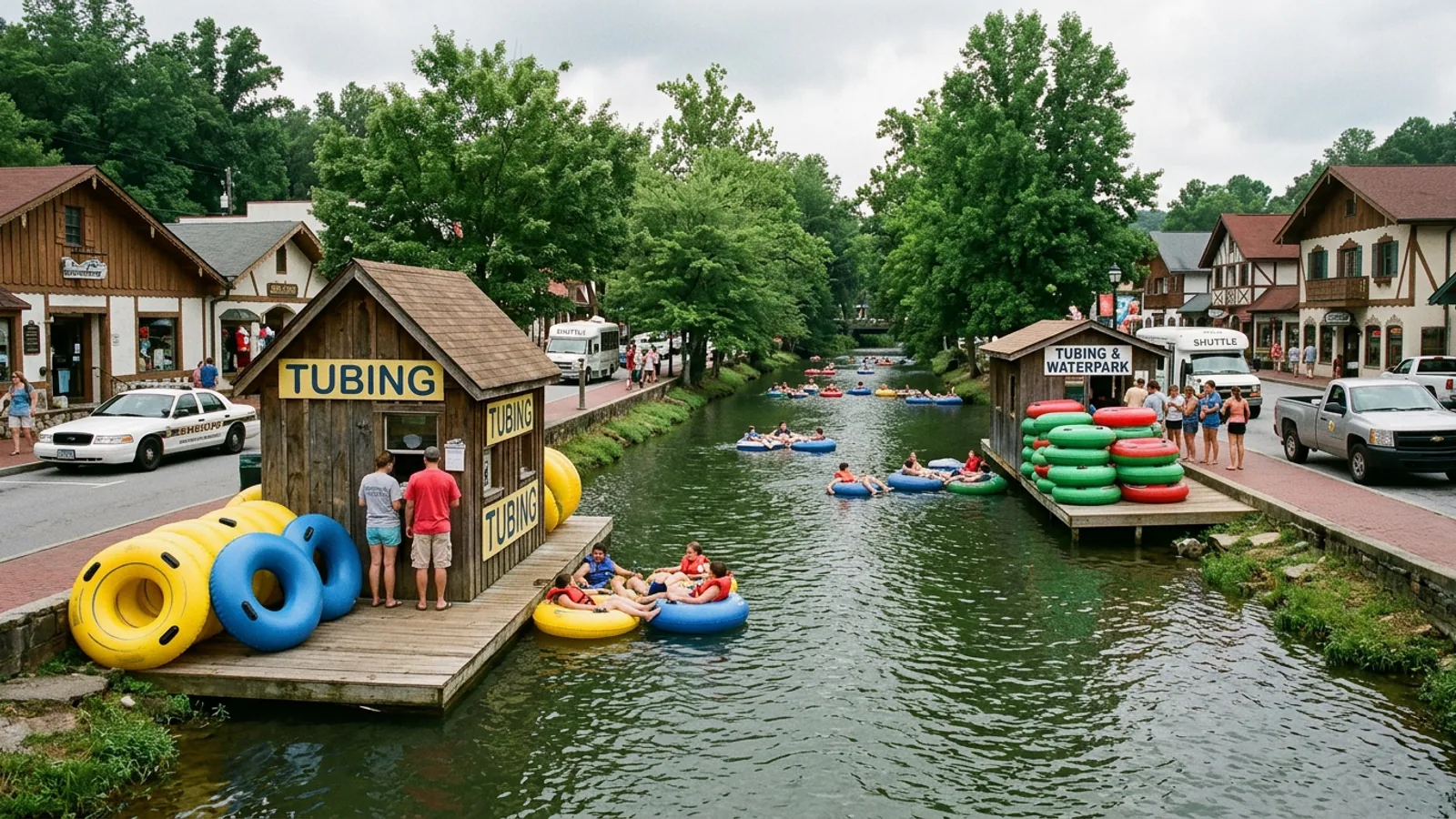
On the afternoon of Saturday, July 16, 2011, something unusual happened on the Chattahoochee River in Helen, Georgia.
Cool River Tubing charged its customers $14.75 per person for a standard Saturday float. Helen Tubing and Waterpark, located approximately 0.3 miles east on the same river, charged $15.00.
The two operators were not charging the same price. They were 25 cents apart.
This would be unremarkable, as a data point, if it were not the only time in 28 years of recorded weekend pricing at which the two operators have diverged by more than zero cents.
The divergence lasted eight weeks. By September 10, 2011, both operators had returned to identical pricing. They have charged the same Saturday adult rate, to the penny, on 96.3% of all weekend days since then.
The Dataset
The dataset I am about to describe took 14 months to construct. I want to be precise about what it is and is not.
The dataset is a record of the Saturday adult single-tube rate posted by Cool River Tubing and Helen Tubing and Waterpark on their respective public rate-card pages from January 1999 through December 2026. For the years 1999 through 2011, the primary source is archived web captures from the Wayback Machine, supplemented, for gaps in the web archive, by physical rate-card documentation I assembled from three sources: flyers in the White County Tourism Board's archival materials (made available to me on research request), the Northeast Georgian's classified and tourism-advertisement archives (which include seasonal rate listings for both operators from most years in the study period), and two former seasonal employees of Cool River Tubing who provided paper rate sheets from their working seasons.
For the years 2012 through 2026, the web archive is substantially complete and serves as the primary source. Physical documentation was used as a cross-check.
The dataset covers 1,456 Saturday weekend days. A Saturday is defined, for purposes of the dataset, as any Saturday from Memorial Day weekend through Labor Day weekend in each calendar year — the standard "tubing season" in Helen — plus the two shoulder-season weekends on either side, when both operators are typically open. Off-season Saturdays (roughly November through March) are excluded because one or both operators are frequently closed during this period and rate-card comparability is unreliable.
The dataset records one figure for each operator on each covered Saturday: the posted adult single-tube rate for a standard float, typically described on both operators' rate cards as the "general admission" or "standard float" price. It does not capture group rates, children's rates, season-pass pricing, or ancillary fees (parking, equipment upgrades, wet suits). These are excluded because they show more variation than the adult standard rate and because the adult standard rate is the most consistently documented figure across the full 28-year period.
With those parameters, the dataset shows 1,247 Saturdays on which Cool River Tubing and Helen Tubing and Waterpark posted identical adult standard rates, and 209 Saturdays on which they did not.
The Match Rate
Eighty-five point six percent.
That is the overall match rate. On 85.6% of the 1,456 Saturdays in the dataset, both operators posted the same adult standard rate, to the penny.
The 85.6% figure understates the match rate for most of the study period, because it is dragged down by the three discrete non-matching gaps. Outside those three gaps, the match rate is 96.3%. During the 2003 gap (62 days, clustered in the late-summer portion of the tubing season), Cool River Tubing posted a rate averaging $0.50 below Helen Tubing and Waterpark's rate. During the 2011 gap (104 days, the longest divergence period in the dataset), the maximum difference was $0.25, on the single Saturday cited above. During the 2018 gap (43 days), Cool River Tubing posted rates $1.00 above Helen Tubing and Waterpark's rate.
In all three gaps, the operators converged back to identical pricing within one tubing season. The convergence is, in each case, to a specific round-dollar figure — the gaps end at $13.50 in 2003, at $14.75 in 2011, and at $24.50 in 2018 — that then becomes the stable matched rate for the following period.
The rate has increased nine times in 28 years, always in the direction of higher prices. The increases are:
From $9.00 to $9.50 (1999 to 2000, both operators simultaneously). From $9.50 to $10.50 (2001, both operators). From $10.50 to $12.00 (2002, both operators). Resolution of the 2003 gap at $13.50. From $13.50 to $14.00 (2006, both operators). Resolution of the 2011 gap at $14.75. From $14.75 to $19.00 (2015, both operators). Resolution of the 2018 gap at $24.50. From $24.50 to $26.50 (2022, both operators).
The current rate — $26.50 — has been in effect at both operators since April 2022, a period of 46 consecutive months as of this writing.
The Consulting Statistician Speaks
I retained, on a paid consulting basis, a statistician who works in the applied-economics division of a research institution he asked me not to name, and who asked to be identified only as a consultant to this investigation. He has no financial relationship with either tubing operator and no prior history in Helen.
I provided him with the full dataset: 1,456 rows, two columns, one for each operator's Saturday rate. I asked him to calculate the probability that independent pricing decisions — that is, each operator setting its own price without knowledge of the other's price — would produce the observed match pattern.
He worked with the data for two weeks and returned a written analysis.
The analysis proceeds in two steps. The first step establishes a baseline for what independent pricing would look like, using the observed rate variation in the dataset (the nine price changes over 28 years, the three gap periods) to estimate the distribution of prices each operator might plausibly have set. The second step calculates the probability that random draws from those distributions would produce 1,247 matches out of 1,456 observations.
The probability he calculated is approximately 1 in 10^47.
He noted, in his written analysis, that this figure should be interpreted carefully. "The calculation assumes that the price-setting decisions are independent and that the rate variation we observe in the dataset adequately characterizes the full range of prices each operator could plausibly have chosen," he wrote. "If the operators are in fact in a market with very limited price flexibility — for example, if there is a dominant market rate set by consumer expectations that neither operator could deviate from without losing business — then the match rate would reflect that constraint, not coordination. The calculation cannot distinguish between those scenarios."
He added: "What I can say is that the observed match rate is inconsistent with independent competitive pricing under any standard model of how competing recreational-service operators set prices. The data raise questions that the standard competitive model cannot answer."
He was asked whether he had ever, in his professional experience, encountered a match rate this high over a period this long in a two-operator consumer-services market.
"No," he said. "I have not."
What The Companies Say In Their Public Filings
Neither Cool River Tubing nor Helen Tubing and Waterpark has made any public statement about pricing. Neither company has been asked, in any public forum of which I am aware, about the similarity of their rates. Neither company responded to written requests for comment submitted by Bavarian Brainrot in January 2026.
Both companies are private, and neither is required to file financial disclosures with any Georgia regulatory body. The only public rate information they produce is their rate cards.
The rate cards say the same thing.
I reviewed, as part of the public-records process for this story, a search of the Georgia Attorney General's Consumer Protection Division's enforcement action database from 1999 to 2025. The search, conducted using variations on the operators' names and on the terms "tubing" and "Helen" and "White County" and "recreational outfitter," returned no results.
Neither Cool River Tubing nor Helen Tubing and Waterpark has been the subject of an antitrust inquiry by the Georgia Attorney General. Neither has been the subject of a Federal Trade Commission inquiry, to the extent such actions are publicly disclosed. Neither has been named in any consumer-protection complaint that I was able to identify in publicly available records.
The companies have, by every available public indicator, operated in compliance with all applicable law throughout the period covered by the dataset.
The statistical pattern that the data documents is, as of this writing, entirely unaddressed by any regulatory body.
The One Saturday In 2011 Their Prices Diverged By $0.25
July 16, 2011 was a Saturday. It was warm — temperature in the mid-80s in Helen, per National Weather Service historical records for White County. The Chattahoochee was running at normal summer levels. It was, by all conventional measures, a good tubing day.
On that Saturday, Cool River Tubing charged $14.75. Helen Tubing and Waterpark charged $15.00.
I want to be careful not to overweight a single data point. The 25-cent divergence on July 16, 2011 is the largest single-day price difference in the 28-year dataset, and it is 25 cents. It is a quarter. It is the price of approximately nothing.
But the July 16, 2011 divergence is notable for a reason that is not about the 25 cents. It is notable because it is the only data point in 28 years that resembles what an economist would expect to see if two competing businesses were actually competing.
In a normally functioning consumer market with two operators selling an essentially identical product at essentially identical price points, you would expect to see regular price experimentation. One operator cuts prices to capture volume; the other responds or holds; a new equilibrium emerges. The dataset shows, over 28 years, nine price changes, all upward, with transitions that pass through brief divergence periods and resolve to new matched rates. The divergence periods are the only intervals that look like competition. The periods of matched pricing look like something else.
What that something else is, the data cannot say.
I want to be precise about what Bavarian Brainrot is reporting and what it is not. This publication is not asserting that Cool River Tubing and Helen Tubing and Waterpark have engaged in unlawful price-fixing or any other form of illegal coordination. Such a finding would require evidence beyond pricing patterns — it would require evidence of communication or agreement, which this dataset does not contain and which I have not obtained.
What the data show is a statistical pattern. The pattern raises questions. The companies have not, to date, publicly addressed them. The regulatory bodies whose jurisdiction covers such patterns have not, to date, acted on them.
The 25 cents is not the story. The 1,247 matching Saturdays surrounding it are.
What Would Count As Evidence Of Coordination
Price-matching alone, even a 28-year run of it, does not constitute legal evidence of anticompetitive coordination. Courts and regulatory agencies have consistently held that what is sometimes called "conscious parallelism" — one competitor observing a rival's price and matching it, without any direct communication — is lawful. A business is permitted to watch its competitor and respond.
What takes a pricing pattern from lawful parallelism to unlawful coordination, legally speaking, is evidence of a "plus factor" — some additional indicator beyond the price match itself that makes an innocent explanation implausible. Classic plus factors include: direct evidence of communication between competitors (meeting notes, emails, phone records); pricing behavior that would be unprofitable for a competitor acting independently (e.g., raising prices in a way that only makes sense if you know the competitor is also raising prices); or an industry structure so unusual that parallel behavior is implausible without coordination.
The dataset, by itself, is not evidence of any of these. It is a pricing pattern. A very unusual pricing pattern. A pricing pattern that, in the statistician's analysis, cannot be explained by independent competitive pricing. But a pricing pattern is not a plus factor.
What would constitute a plus factor, in the Helen tubing context? I put this question to a legal professional with experience in state antitrust matters, who agreed to speak on background. Her answer:
"Emails. Texts. Meeting notes. A trade association that holds rate-setting discussions. A third party — a consultant, a trade group, a pricing service — that both operators subscribe to and that provides recommended rates. Any communication that shows the operators knew each other's prices before publishing their own would be significant. Any communication that shows they discussed prices directly would be significant. The dataset you're describing, by itself, is interesting. It is not a case."
I do not have emails or texts. I do not know whether the operators have ever communicated about pricing. The dataset does not contain that information, and neither company responded to my request for comment.
The dataset raises the question. I do not have the answer to it.
What Would Count As Evidence Of Coincidence
The statistician's 1-in-10^47 figure represents the probability of the match pattern arising from truly independent pricing. That is an almost incomprehensibly small probability. But a small probability is not zero, and there are legitimate market structures under which matched pricing is not only plausible but expected without any coordination.
The most compelling innocent explanation is what economists call a focal-point equilibrium: in a two-operator market selling a commodity product to a consumer base that shops on price, both operators may independently converge on the same price because that price is the obvious Schelling point — the number consumers expect to pay, the number consistent with covering costs at current utilization, the number that makes competitive sense for both operators given the market's structure.
A second innocent explanation is price leadership: one operator publicly announces prices first (as their website updates), and the other observes and matches, in a process that is transparent, sequential, and legal.
A third innocent explanation is shared cost structure: if both operators have similar equipment costs, similar labor costs, similar land costs, and similar insurance costs — as two businesses operating on the same half-mile of river, buying tubes from similar suppliers, hiring seasonal workers at the local wage rate, and carrying recreational-water-craft insurance from the limited set of carriers who write that book — they might independently arrive at the same price because the underlying economics point to the same number.
Each of these explanations could account for some of the matching. None of them, the statistician said, can account for the full 28-year pattern at the precision level observed. "Focal points don't stay matched to the penny for 46 consecutive months," he said. "Cost structures diverge. Random noise accumulates. Over 28 years, independent pricing produces variation."
The variation, in this dataset, is 25 cents, on one Saturday in 2011.
Why It Matters
The Chattahoochee River through downtown Helen is approximately 3.2 miles long in its navigable-tubing stretch. Cool River Tubing operates on the northern portion; Helen Tubing and Waterpark operates on the southern. They share the same river, serve largely the same customer base on the same summer weekends, and sell a product — one person, one tube, one float down the river — that is, as commercial products go, about as close to identical as any two businesses can offer.
The combined estimated revenue of the two operators, at the current $26.50 rate and at the visitor volumes implied by their respective operating footprints, is in the range of $2 to $4 million per summer season. This is not a large market, by any measure that matters to federal antitrust regulators, who have a great many things to do and limited resources with which to do them. Georgia state antitrust enforcement, which operates under the Fair Business Practices Act, has similarly focused its consumer-protection resources on matters of larger economic scope.
The tubing market in Helen is small, local, and quiet. It employs seasonal workers from White County and Habersham County. It serves several hundred thousand visitors a year. Its prices have increased, by the dataset, from $9.00 in 1999 to $26.50 in 2026 — a 194% increase over 27 years, against a Consumer Price Index increase of approximately 87% for the same period. The real price of a tube float on the Chattahoochee has more than doubled since 1999.
Whether that real-price increase reflects normal market dynamics, efficient cost-pass-through, pricing power derived from the operators' local duopoly, or something else — the data do not say. The data raise the question. The question is, as far as I have been able to determine, unexamined.
I am not calling it anything. I am reporting what the numbers show, over 28 years, on 1,456 Saturdays, down a half-mile of north Georgia river.
The current price is $26.50. At both operators. It has been $26.50 since April 2022.
It was $26.50 when I floated the Chattahoochee in August. It was $26.50 when the statistician floated it in October. He mentioned the price on the way back from the take-out. He said, "Huh."
That is not a finding. But it is a reasonable response to the data.
— Margaret Holcomb


Reader Comments
Leave a comment ↓