On March 2, 2026, Alpine Helen/White County Convention and Visitors Bureau Director Jerry Brown met with Adam Zappia of Zartico, a Park City, Utah-based destination-analytics company, to discuss what the CVB's subsequent monthly report to the Helen City Commission described, in its entirety, as a "new 'Benchmarking' platform." The report allocated 11 words to the meeting. It did not describe the platform's underlying data architecture, its pricing structure, its contractual terms, or the provenance of the cellular-device-location datasets from which Zartico's analytics are derived. The remaining 14 meetings on Director Brown's March schedule received comparable brevity. The meeting with Zappia was listed second, between "IPW regroup with Explore Georgia" on March 3 and a workshop on a separate "new AI buddy platform" hosted by ITI Digital on March 4.
Zartico, Inc., founded in 2020 and headquartered at 1910 Prospector Avenue, Suite 201, Park City, UT 84060, markets a suite of destination-intelligence products to convention and visitors bureaus, destination marketing organizations, and state tourism offices across the United States. Its core analytics layer ingests de-identified cellular-device-location data — commonly referred to in the industry as "mobility data" — supplied by third-party aggregators who license raw location pings from mobile-application software development kits embedded in consumer smartphone apps. The data, once processed, allows a subscribing DMO to track visitor origin markets, dwell times, spending patterns, and travel corridors with a granularity that the CVB's prior analytics tool — its website's Google Analytics dashboard, which recorded 108,000 visits and a 49.50 percent bounce rate in March 2026 — cannot approach.
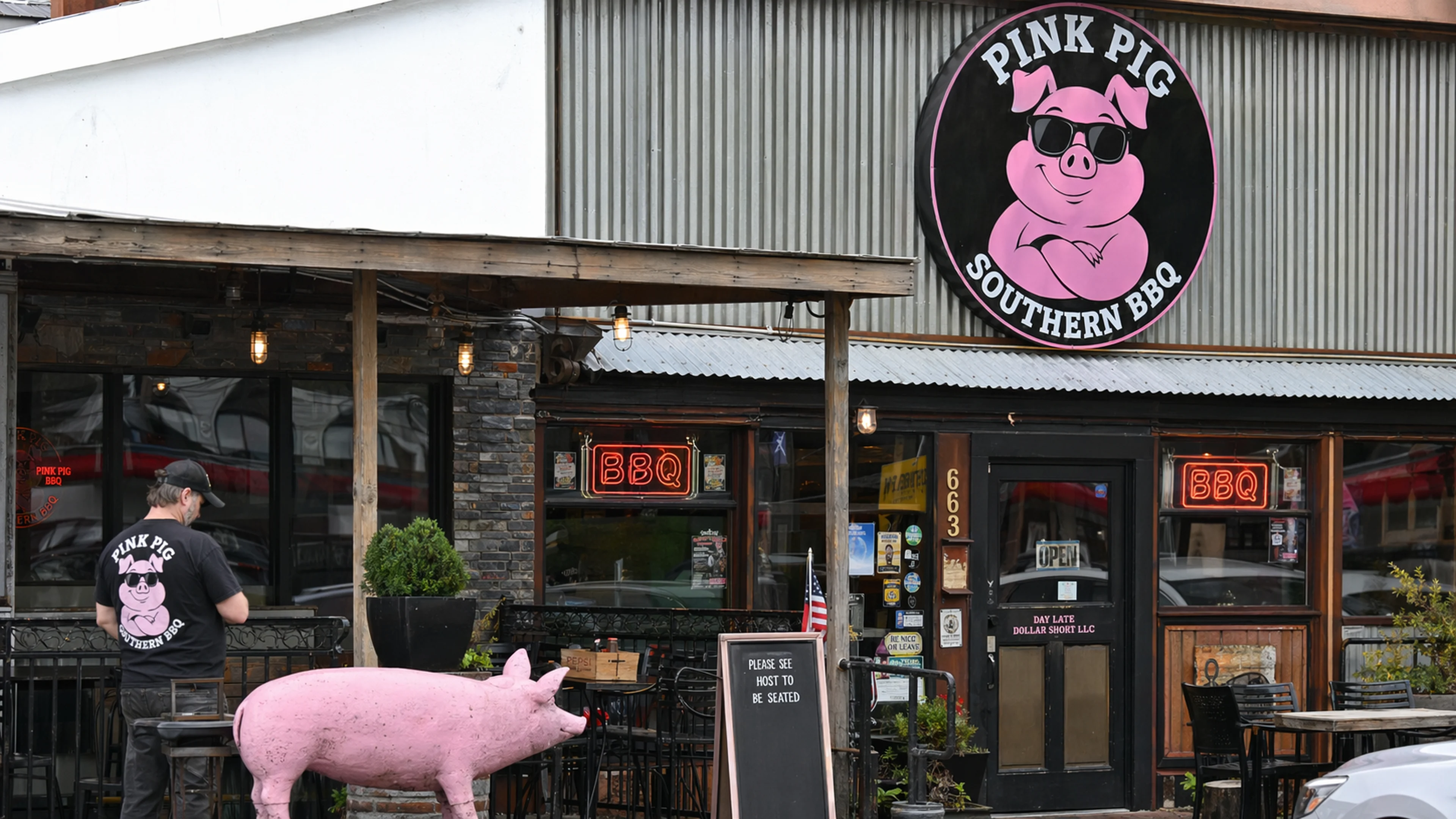
The same category of mobility dataset underlying Zartico's tourism-analytics product has, over the past decade, been marketed — in its raw-feed form, under different branding, by different vendors — to firms serving the defense, intelligence, and law-enforcement analytics markets. Bavarian Brainrot does not suggest that Zartico itself operates in those markets, and Zartico's public product positioning is firmly in the tourism-destination-marketing sector. We note only that the raw-source lineage of commercial mobility data, traced through several licensing tiers, reaches categories of end use that the Helen City Commission's April 21, 2026 agenda — which devoted its attention to a parking-lot contract on Hoen Strasse submitted by Jeff Ash, and to a liquor-pouring addition for Day Late Dollar Short LLC d/b/a Pink Pig Southern BBQ at 663 Brucken Strasse — did not appear calibrated to evaluate.
The supply chain is not complicated. It is merely long. A consumer downloads a weather app, a coupon app, or a traffic app. The app's SDK collects latitude-longitude pings at intervals ranging from 30 seconds to five minutes. The app developer sells those pings, stripped of direct personal identifiers but retaining device-advertising IDs and precise coordinates, to a first-tier aggregator. The first-tier aggregator cleans, normalizes, and re-licenses the dataset to second-tier analytics firms. Some of those second-tier firms build tourism dashboards. Others build retail-foot-traffic models. Others — operating under different contract vehicles, different branding, and different sales channels — build products marketed to government agencies and defense contractors for pattern-of-life analysis in contexts Bavarian Brainrot is not equipped to summarize in a local newspaper serving a town of fewer than 700 residents.
"The technical distinction between a tourism-mobility product and a defense-mobility product is, at the raw-data layer, approximately zero," said Dr. Wilhelm Brüning, formerly of the Bavarian State Institute for Regional Cultural Geography, reached by phone at his home in Dahlonega. "The distinction is in the processing, the visualization, and the contract terms. The bits are the same bits. A latitude-longitude ping from a device on Bruckenstrasse does not know whether it is being ingested by a DMO benchmarking dashboard or by something else entirely. It is a coordinate. It goes where it is sent."
Dr. Brüning, who has consulted on geospatial data governance for municipal clients in Northeast Georgia since what he described as "the unpleasantness with the Sautee cell-tower audit in 2017," said the adoption of mobility-data platforms by small-town CVBs represents a structural milestone that most city commissions process, if they process it at all, as a line item.
Zartico's Benchmarking Platform, specifically, allows a subscribing destination to compare its visitor metrics — origin-market mix, average length of stay, visitor spending per trip, repeat-visitation rate — against a peer set of comparable destinations. The platform's public case studies cite deployments in Park City, Savannah, and a number of Georgia DMOs. A source familiar with the platform's pricing who declined to be named said annual subscription costs for a destination of Helen's size fall in a range between $18,000 and $36,000, depending on module selection — a figure that would place it in the same budgetary neighborhood as the $18,000-to-$20,000 hotel-and-nightly-rental audit the Commission approved at its March 17, 2026 meeting to cover six properties.
The CVB's March 2026 financial report to the Commission documented $151,428 in Hotel/Motel Tax revenue for the month, against a nine-month fiscal-year-to-date total of $2,201,494 — a 7.62 percent increase over the same period in fiscal year 2025. The CVB placed advertising that month in Southern Living Magazine, South Carolina Living, Carolina Country EMC, North Georgia Living, Southbound Magazine, Blue Ridge Country, Atlanta Magazine, Georgia EMC, Georgia Design, Georgia's Great Places, and AAA Explorer (Alabama). It recorded a single media placement on Only in Our State, syndicated through AOL.com and Yahoo News, concerning Babyland General Hospital, that generated 9.1 million impressions and an estimated media value of $3.3 million. The benchmarking platform, if adopted, would allow the CVB to measure whether any of those 9.1 million impression-recipients subsequently appeared, as a cellular-device ping, within the municipal boundaries of Helen, Georgia 30545.
Margaret Holcomb, reporting for Bavarian Brainrot, asked Gunter the Pretzel Vendor, who operates a cart near the intersection of Bruckenstrasse and Main Street, whether he was aware that a mobility-data analytics platform could, in principle, track the origin zip code, dwell time, and spending corridor of every device that passed within 12 feet of his cart.
"I know when they are going to buy a pretzel before they know," Gunter said. "They slow down at the corner. They look at the menu. They look at their wife. They look at the menu again. This takes between 11 and 14 seconds. I do not need a satellite for this."
He declined to comment on the platform's benchmarking capabilities.
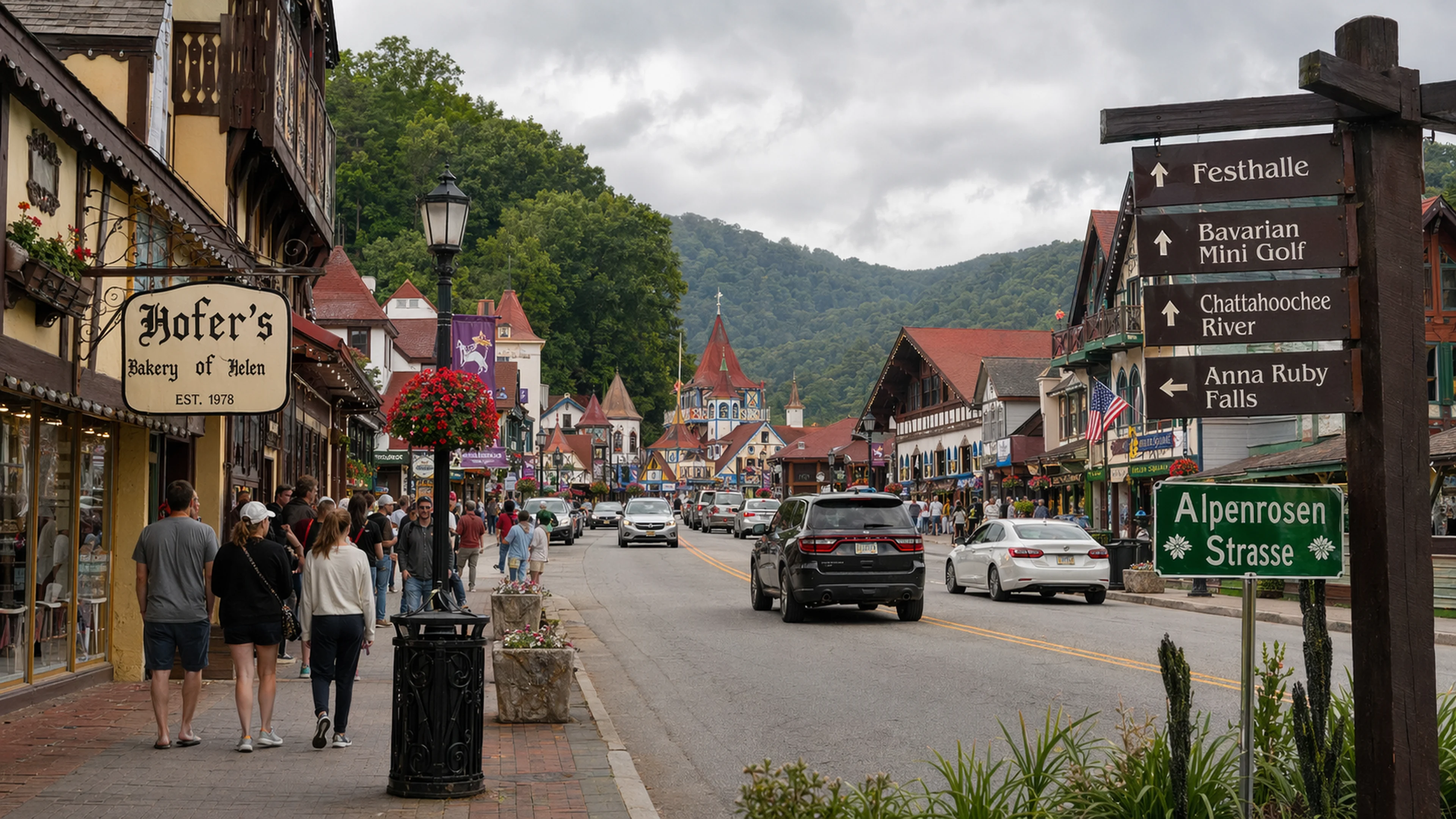
What Helen is now positioned to do, should the Commission approve a Zartico subscription — a decision that, as of the April 21, 2026 agenda packet prepared by City Clerk Marilyn M. Chastain, has not appeared as an action item — is run visitor-mobility analytics on the roughly 2,570 humans who visited the Welcome Center in March 2026, plus the substantially larger population of device-carrying tourists who did not visit the Welcome Center but whose phones nonetheless emitted location pings as they moved along Main Street, crossed the Chattahoochee on foot, floated it via Cool River Tubing, or drove Robertstown Road toward Anna Ruby Falls. This is a reasonable tourism-marketing activity. It is the same activity performed by CVBs in Savannah, Asheville, and Gatlinburg. It is also, at the structural level of data-supply-chain architecture, the same category of activity that a defense-analytics firm would perform on a different geographic zone, for different clients, under a different contract vehicle, with a different slide deck.
No conclusions are drawn beyond this. Director Brown's meeting on March 2 was 14 words on a monthly report. The platform is standard in the DMO industry. Helen, Georgia — population sub-700, third-largest tourist destination in the state per the White County Resilience Plan prepared by iParametrics for the Georgia Mountains Regional Commission, a "Certified City of Ethics" per its own letterhead, and a Tree City USA since 2002 — is now, or will shortly be, a node in the American tourism-mobility-data economy. The bits, as Dr. Brüning observed, do not know where they are going.
The CVB's next monthly report is expected at the May Commission meeting. It will likely be brief.





Reader Comments
Leave a comment ↓