The Forty-Percent Lake: City Of Helen Acknowledges That Roughly Half Its Treated Water Has Vanished
The City of Helen, Georgia, pumps treated water into a distribution system every day. On the public record, as of the City Commission's December 16, 2025 regular meeting, approximately 40 percent of that water does not arrive at a metered point of sale. Engineering Management, Inc. engineer Fletcher Holliday, who disclosed the figure, characterizes it as an opportunity for zone-meter installation. A less diplomatic description might characterize it as a hydrological intelligence failure.
ByMargaret Holcomb· Senior CorrespondentPublished December 17, 2025 at 2:30 PM UTC · 8 min read
Premium
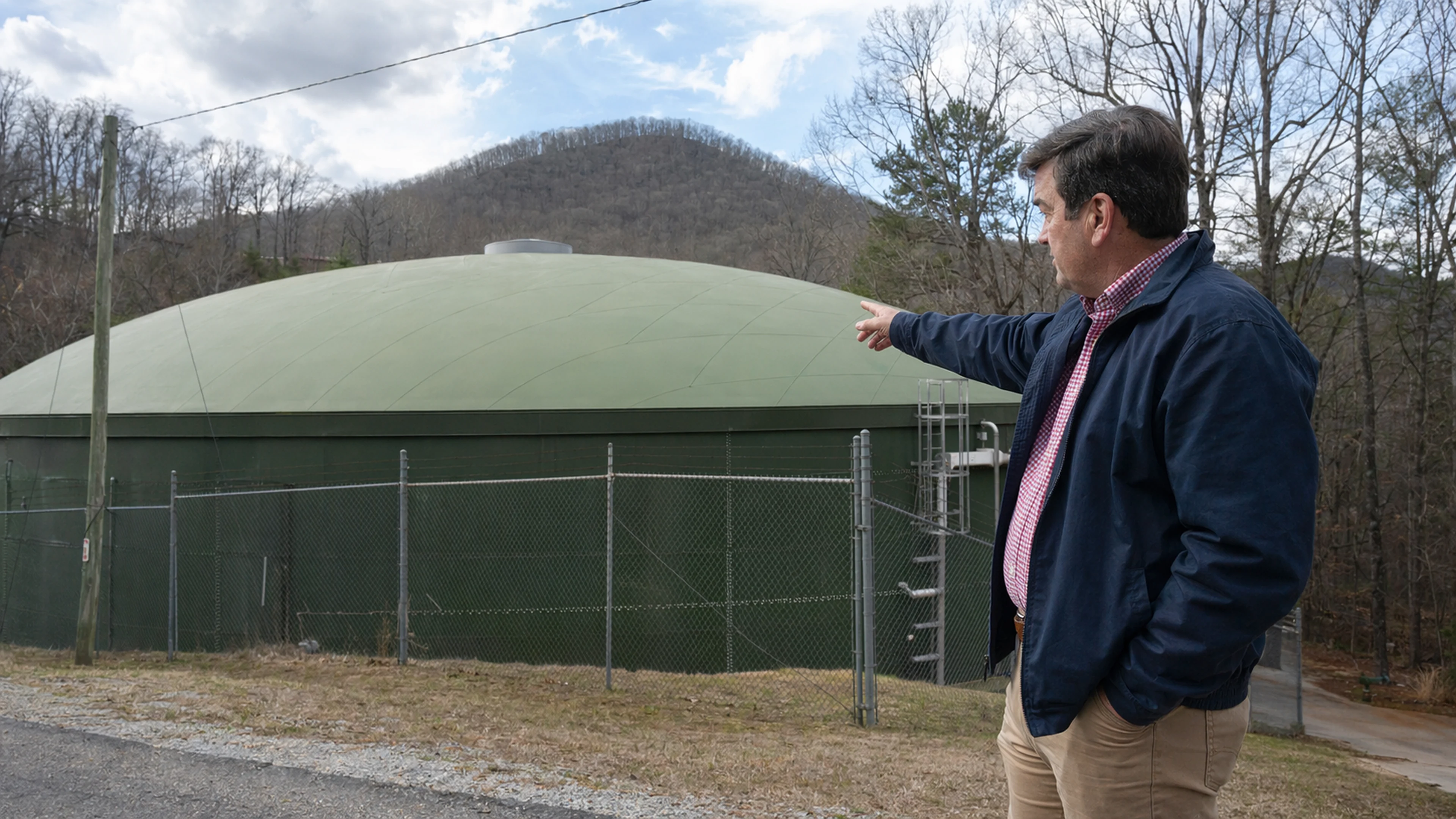
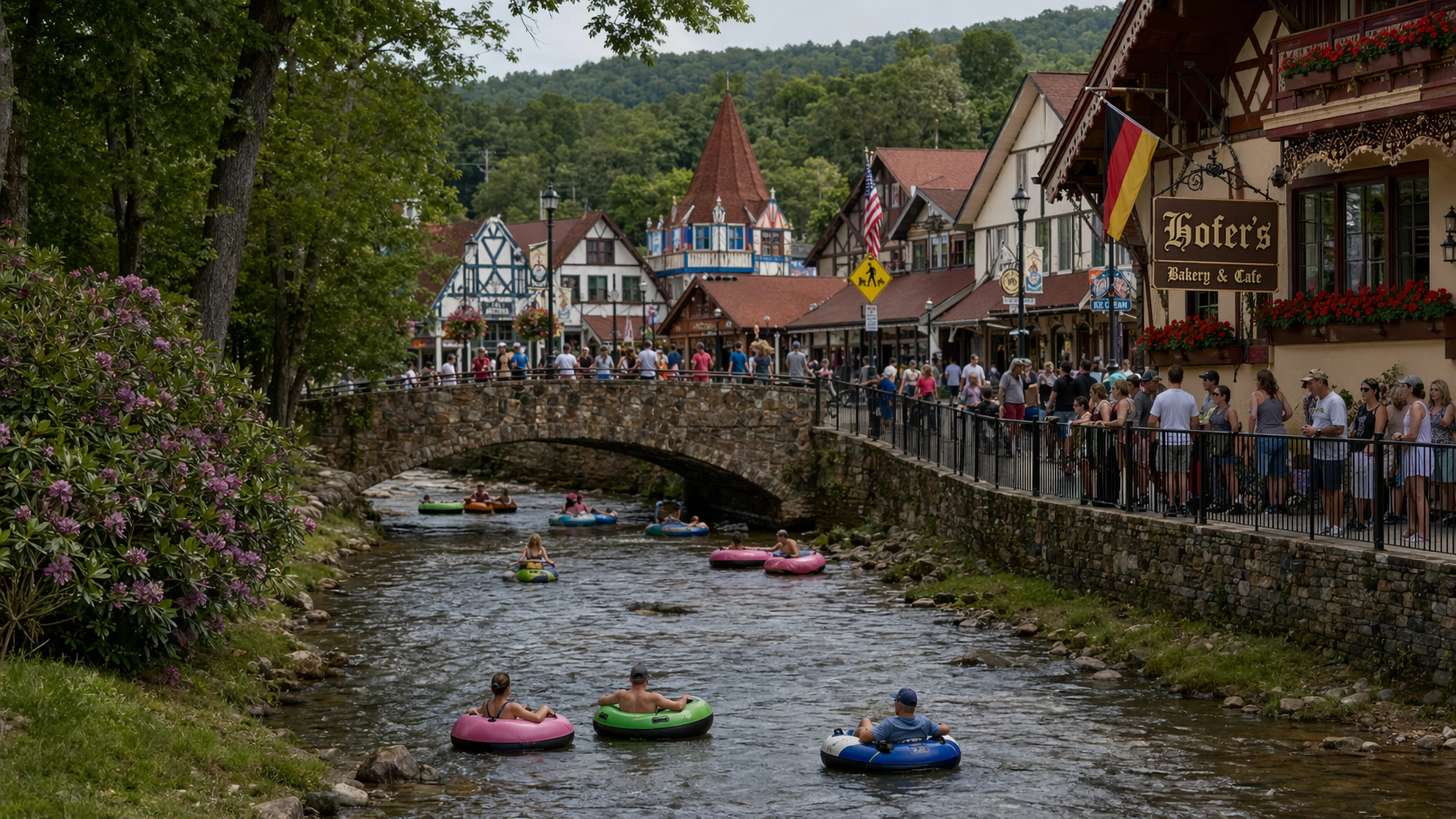
Helen Public Works Director Jack Morgan, right, at the city's primary ground-level water storage tank on Robertstown Road, Wednesday afternoon. The tank, installed in 2011, holds approximately 500,000 gallons. Of the water it dispenses into the distribution system, approximately 200,000 gallons per day — 40 percent of the total — does not arrive at any metered point of sale, per engineering disclosures filed with the City Commission the preceding Tuesday. (Photo: Bavarian Brainrot / Margaret Holcomb)
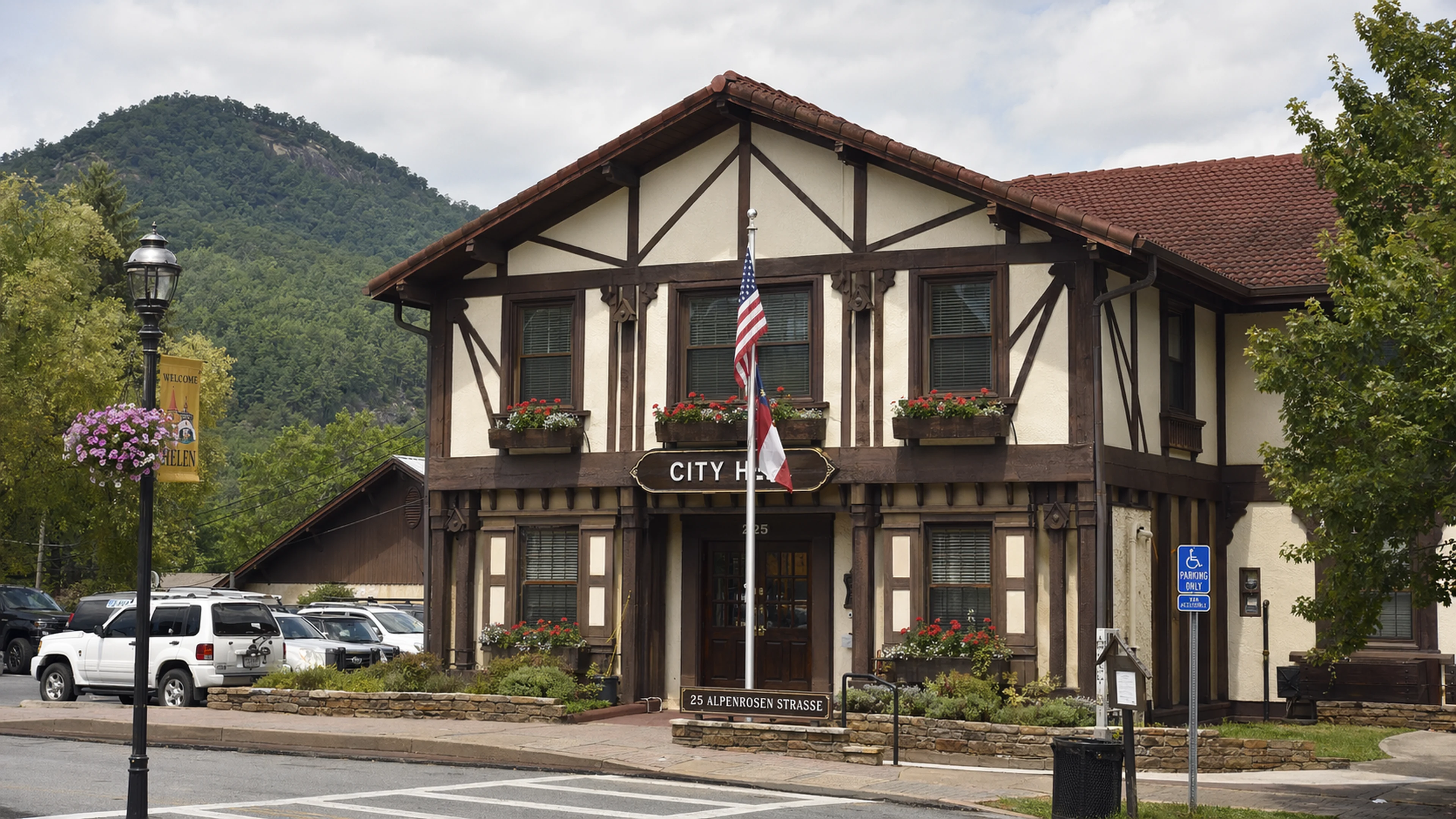
At approximately 10:40 a.m. on Tuesday, December 16, 2025, during the Engineering section of the Helen City Commission's regular monthly meeting — after the financial report, after the police and fire reports, and before the Public Works and Building and Zoning updates — Fletcher Holliday, the second-assigned engineer at Engineering Management, Inc., rose from his seat at the staff table in the Commission chambers at 25 Alpenrosen Strasse, unclipped a one-page typed summary from his manila folder, and informed the five sitting Commissioners that the City of Helen has, at present, a water loss of approximately 40 percent.
The disclosure, as preserved in the meeting minutes prepared by City Clerk Marilyn Chastain and approved at the following month's regular meeting, reads in full: "Fletcher Holliday explained that the City currently has a water loss of approximately 40% and that by installing 6 meters to cover the entire city that they can help determine where the loss is occurring. Motion to approve moving forward with the design of the system made by Commissioner Steve Fowler, 2nd by Commissioner Lee Landress. Motion approved with a unanimous vote of the Commission."
The motion consumed, per the minutes' pacing, approximately three minutes. No Commissioner asked a follow-up question. No member of the public was present to comment. The six zone meters — a distributed measurement network intended to partition the city's distribution system into discrete accounting sectors — were authorized to proceed into design.
"Non-revenue water," as the metric is technically known, is the category of municipal water-utility performance measuring the difference between water that enters the distribution system from the treatment plant, and water that arrives, measured, at a paid point of sale. The difference is not, in any ordinary municipal water system, zero. Some water is lost to unmetered uses — flushing mains, fire hydrants, street cleaning. Some is lost to measurement inaccuracy, with meters at the customer end reading low or registering intermittently. Some is lost to unauthorized consumption. And some is lost to the physical failure of the distribution system itself: main breaks, leaking joints, deteriorated service lines, and — in karst topography, which Helen's location in the lower White County limestone belt arguably resembles — slow subsurface seepage through geological formations that no municipal engineer can fully characterize.
The American Water Works Association, in its Manual M36, characterizes a well-managed U.S. water system as operating at approximately 10 percent non-revenue water or better. A figure above 15 percent raises operational concerns. Above 25 percent, a system is typically considered in need of corrective investment. Above 30 percent is the threshold the U.S. Environmental Protection Agency, in its 2010 report on Control and Mitigation of Drinking Water Losses in Distribution Systems, identifies as a signal of material infrastructure distress.
Non-Revenue Water · Helen vs. Benchmarks
Helen Loses 40% of Treated Water Before a Paid Meter
Per Engineering Management, Inc. engineering update to the City Commission, December 16, 2025.
AWWA "well-managed"
10%
U.S. urban average (EPA)
14%
Georgia EPD urban avg.
15%
AWWA "investment needed"
25%
EPA "material distress"
30%
Flint, MI (2015 peak)
30%
Helen, GA (2025)
40%
Bar length is percentage of treated water unaccounted for (non-revenue). Flint comparison is to the 2015-2016 crisis period; Helen's figure carries no public-health implication — its treated water meets Georgia EPD drinking-water standards per the 2025 Water Quality Report.
Helen, per Mr. Holliday's disclosure, is operating at 40 percent.
For comparative reference: during the peak of the Flint, Michigan water crisis of 2015 and 2016 — a period of significant public-health and engineering documentation — the City of Flint's non-revenue water rate was estimated at approximately 30 percent. This is not to suggest that Helen is experiencing a public-health crisis; Helen's treated water continues to meet Georgia EPD drinking-water standards, and the city's most recent Water Quality Report, published in 2025, reports no exceedances of any monitored contaminant. Helen's loss is a revenue loss, not a safety loss. The missing water is not missing from anyone's tap. It is missing from the revenue meter.
The question is where it goes.
Dr. Wilhelm Brüning, the independent scholar whose work on municipal infrastructure in Alpine and Appalachian communities has spanned four decades, characterized Helen's situation with a geologist's caveat. "It is not fair to say that water is missing from Helen," Dr. Brüning told Bavarian Brainrot by telephone Thursday afternoon. "It is fair to say that water is moving through Helen without stopping at any of the places where the city can charge for it. The specific hydrogeology of the Chattahoochee river valley, the porous bedrock of the White County limestone belt, and the high annual rainfall of the north-Georgia escarpment are the exact opposite of a watertight basin. Some fraction of the treated water, once in the distribution system, is almost certainly exiting through formations the city does not own and has never surveyed."
A civil engineering consultant who has worked on comparable rural-municipal water systems, and who agreed to speak with Bavarian Brainrot on condition of anonymity due to ongoing professional relationships with Georgia EPD, characterized Mr. Holliday's zone-meter proposal as "the correct first step." The consultant continued: "Zone meters do not find the leak. They tell you which sector the leak is in. From there, you still have to do the digging. In a city the size of Helen, with a 40-percent loss rate, you can expect to find the dominant loss factor within eighteen months of zone-meter commissioning. It will not, in most cases, be one dramatic failure. It will be dozens of smaller losses distributed across an aging distribution system. The cost of repair, once identified, will not be trivial."
Engineering Management, Inc. has not, at time of writing, disclosed a cost estimate for the zone-meter installation. The December 16 motion authorized only the design phase; bid documents are expected later in 2026. A rough analog — zone-meter installations in comparably sized north Georgia systems — places the six-meter project in the range of $90,000 to $180,000, before the subsequent repair capital required to address the losses the meters will identify.
Several candidate sources of the missing 40 percent are already known to Helen's engineering and finance departments, though none has been publicly quantified.
First, the Festhalle's ice-dispensing system, installed for Oktoberfest operation, has an estimated peak operational capacity of approximately 4,000 pounds of ice per day. Over the 44-day Oktoberfest season, that represents on the order of 176,000 gallons of water entering the ice matrix — water that, once dispensed into beverages, Festhalle drains, and the downhill Chattahoochee system, is never metered as a sale. Whether this draw is currently accounted for as a city-facility unmetered use or as non-revenue loss is not addressed in EMI's December letter.
Second, the Gypsum Feed Systems Building, whose design is currently 85 percent complete per EMI's April 2026 infrastructure-update letter, will, upon commissioning, consume treated water as a dosing vehicle for calcium-sulfate injection into the distribution system. The process water the feed system consumes is, by definition, non-revenue water that EMI may reclassify as "process use" — a categorical shift that will, on paper, reduce Helen's 40-percent loss figure without reducing the actual volume of water unaccounted for. Whether this paper reduction is planned, and how it will be disclosed, is a question EMI has not publicly answered.
Third, the collection of lodging pools, saunas, and HVAC systems at Helen's larger hotels — including the Holiday Inn Express and Suites at 8100 South Main Street (licensed to Aryana Hotels Inc, with alcohol-license holder Guy Slabbaert), and the under-construction Home 2 Suites Helen (licensed to Perform Motel Helen LLC, also operated by Mr. Slabbaert) — consume water at volumes that, when not sub-metered, can produce the appearance of loss. Neither hotel has, per the Commission's April 17 audit-firm approval, been publicly identified as a target of the $18,000-to-$20,000 tax-compliance audit the Commission approved on March 17 for six Helen lodging locations.
Fourth, and most conventionally, the physical leaks of an aging cast-iron-and-PVC distribution system whose oldest mains date to Helen's 1969 re-alignment and whose newest segments date to the 2011 Robertstown Road expansion. Forty percent loss is consistent with a system carrying a backlog of undetected small failures.
Walker, Pierce & Tuck, CPAs, PC — Helen's auditor of record for at least the past sixteen consecutive fiscal years, and the firm whose signature appears on every Helen annual audit since 2010 — has not, in any audit issued during that span, flagged the city's non-revenue water rate as a material weakness. This is because non-revenue water is not a financial-statement line; it is an operational metric. Auditors are not required, in the ordinary course of an annual financial audit, to audit operations. The 40-percent figure has sat, quietly, in Helen's engineering files for years — unaddressed, unaudited, and, until Mr. Holliday's December 16 disclosure, undiscussed on the public record.
The zone-meter design will proceed through the spring. Commission review of the design, per Mr. Holliday's oral presentation, is anticipated at a regular meeting in the third quarter of 2026. A bid solicitation will follow. Installation, if on the current EMI timeline, will complete in mid-2027. The losses Helen's system is presently incurring — in treated water, in unbilled revenue, and in the capital deferral that has kept the 40-percent figure from being addressed sooner — will continue to accrue until then.
Commissioner Mervin Barbree left the December 16 meeting at 10:55 a.m. The meeting was gaveled to adjournment at 10:54 a.m.


Reader Comments
Leave a comment ↓