

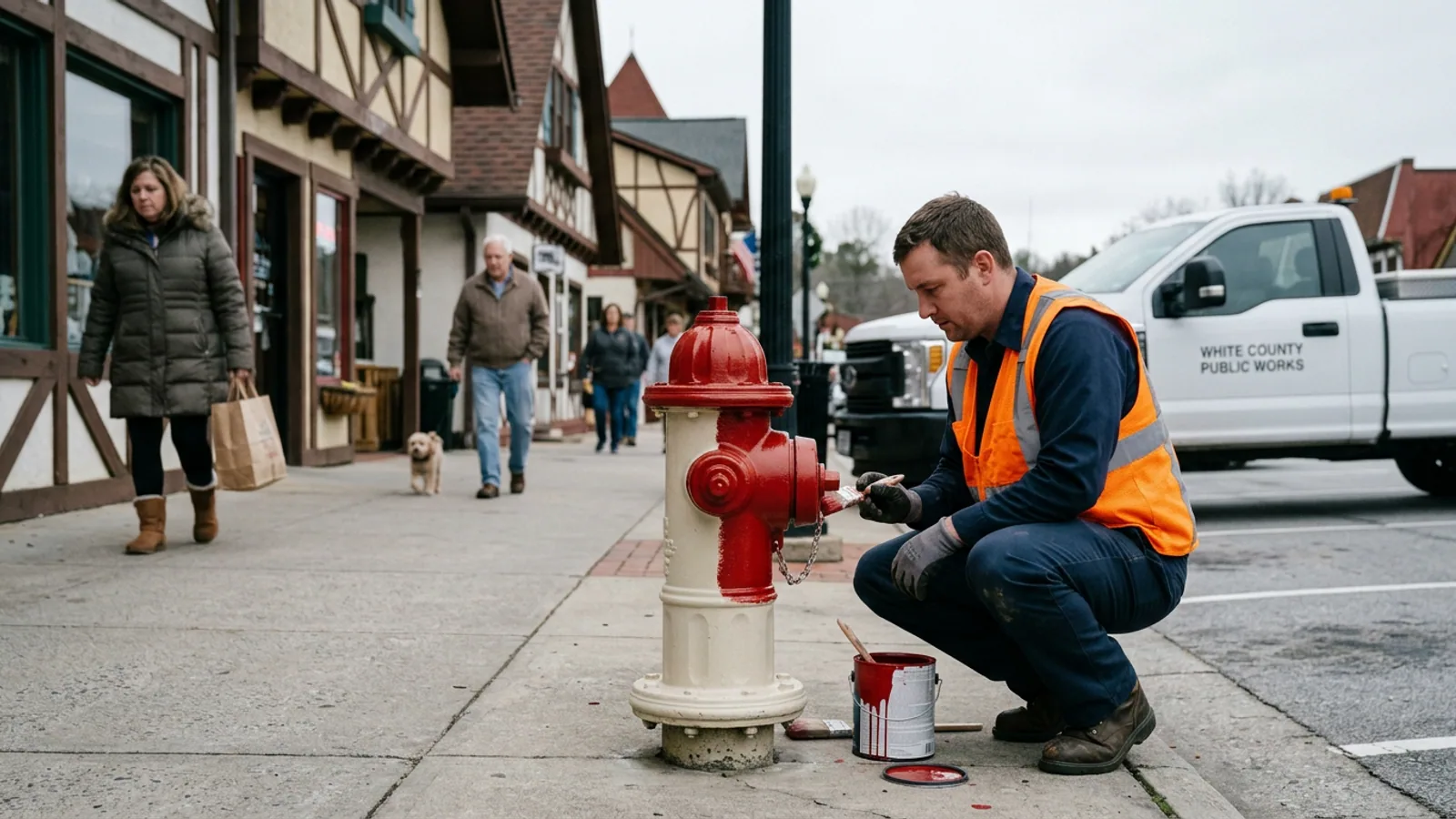
The City of Helen will repaint its entire 147-hydrant fire-hydrant fleet to bring it into compliance with the National Fire Protection Association's standard color-coding system, following a February 18 letter from White County Fire Marshal Dennis Pruett identifying the current paint scheme as non-compliant.
The repainting will proceed at a rate of 16 hydrants per year, which the City Council approved without dissent at its March 11 regular meeting. At that pace, full compliance will be achieved at some point in the first quarter of 2035.
The hydrants are currently painted "Bavarian Cream."
What NFPA 291 Requires
NFPA 291, the National Fire Protection Association's recommended practice for fire flow testing and hydrant marking, specifies a standardized color-coding system for fire hydrant bodies based on the hydrant's rated flow capacity — the volume of water, measured in gallons per minute, the hydrant can deliver at 20 pounds per square inch of residual pressure.
Under the standard, hydrants rated at fewer than 500 gallons per minute receive red bodies. Hydrants rated between 500 and 999 gallons per minute receive orange bodies. Hydrants rated between 1,000 and 1,499 gallons per minute receive green bodies. Hydrants rated at 1,500 gallons per minute or above receive light blue bodies.
The standard further specifies that hydrant bonnets and caps be color-coded by a supplemental system indicating pressure class, independent of the body-color rating.
"Bavarian Cream" does not appear in NFPA 291. It is not a recognized variant of any of the four standard body colors. It falls, by general colorimetric description, in the yellow-white register and is not visually proximate to red, orange, green, or light blue.
The Fire Marshal's Letter
Fire Marshal Pruett's February 18 letter to the Helen City Council, a three-page document reviewed by the Bavarian Brainrot newsroom, opens with a brief statement of purpose: "This office has completed its biennial survey of fire suppression infrastructure within the City of Helen municipal limits and has identified the following compliance matter requiring Council attention."
The letter identifies the Bavarian Cream paint scheme as the sole compliance matter.
It notes that NFPA 291 is a recommended practice rather than a mandatory standard under Georgia law, but states that White County Fire Rescue's apparatus operators "rely on the NFPA 291 visual identification system when operating at structure fires in both the county and municipal jurisdictions" and that Helen's non-standard hydrant color scheme "creates the potential for flow-capacity ambiguity during high-stress fireground operations."
The letter does not describe any specific incident in which the Bavarian Cream scheme caused or contributed to operational confusion. It notes that no such incident has occurred "to this office's knowledge."
Fire Marshal Pruett concluded with a recommendation that the City "develop a transition plan to bring the hydrant fleet into NFPA 291 compliance within a reasonable timeframe" and offered his office's assistance in prioritizing hydrants by flow class.
How Helen Came To Have Bavarian Cream Hydrants
The Bavarian Cream paint scheme dates, per Public Works Director Gene Sattler, to the downtown Helen aesthetic-renovation program of 1989, when the City undertook a coordinated effort to apply consistent Bavarian-village visual standards across downtown streetscape elements, including light poles, benches, trash receptacles, and fire hydrants.
Director Sattler, reached Wednesday, said the scheme had been applied to new hydrants as they were installed and to the existing fleet during scheduled maintenance cycles over the 37 years since its adoption.
He said the City had not, prior to Fire Marshal Pruett's February letter, received any formal notice that the color scheme was non-compliant.
"We've repainted them Bavarian Cream for 37 years," Director Sattler said. "This is the first time anyone has raised an official objection."
He said the City would comply with the Fire Marshal's recommendation.
The 16-Per-Year Schedule
The Helen City Council's March 11 resolution, adopted five to zero, authorizes Public Works to incorporate hydrant repainting into the department's annual maintenance schedule at a rate of 16 hydrants per year, beginning in the 2026 fiscal year.
The resolution specifies that repainting shall be prioritized by flow class, beginning with the City's highest-flow hydrants, which Director Sattler confirmed are concentrated in the Edelweiss Strasse and Bruckenstrasse commercial corridors. Those hydrants, rated at 1,000 gallons per minute or above, will receive green bodies, per the NFPA 291 standard.
At 16 hydrants per year, the City's 147-unit fleet will be fully repainted in nine years and two months, assuming no hydrant additions or replacements in the interim. Full compliance will occur, per Director Sattler's arithmetic, in the first quarter of 2035.
Council Member Teri Hapscomb, at the March 11 meeting, asked whether the rate could be accelerated to achieve compliance sooner. Director Sattler indicated that 16 per year represented the department's maximum capacity given existing staffing and the hydrants' integration with the annual maintenance cycle.
Council Member Phil Runyon asked whether the fire marshal had specified a compliance deadline. Director Sattler confirmed the letter did not include a mandatory deadline.
The resolution passed.
What The New Colors Will Look Like
The NFPA 291 compliance repainting will produce, in the downtown Helen commercial corridor, a visually varied hydrant fleet: some green, some orange, and potentially some red, depending on the flow ratings of the lower-output hydrants at the corridor's edges.
Asked whether the City had given any consideration to the aesthetic impact of transitioning from a uniform Bavarian Cream fleet to a multi-colored NFPA-compliant fleet, Director Sattler said the Council had discussed the question briefly at the March 11 meeting.
"The consensus was that public safety takes precedence," he said.
Council Member Hapscomb, reached Thursday, confirmed this characterization but noted that the downtown aesthetic-consistency question had "come up." She said she expected it might come up again at future meetings as the repainting proceeded and the color transition became visible.
The 1989 downtown beautification program that produced the Bavarian Cream scheme cost, per City records, $74,000 in streetscape-element repainting, of which hydrant repainting accounted for $9,800.
The estimated cost of the NFPA 291 compliance repainting, per Director Sattler's March 11 presentation, is $2,200 per year at 16 hydrants, or $19,800 over the nine-year program.
The first 16 hydrants are scheduled for repainting in May.
— Connor McAllister
Reader Comments
Leave a comment ↓