The Seat Census: Inside Building & Zoning Director Jonah Casper's Eighteen-Week Tour Of Every Chair In Helen
ByMargaret Holcomb· Senior CorrespondentPublished April 23, 2026 at 10:00 AM UTC · 18 min read
Premium
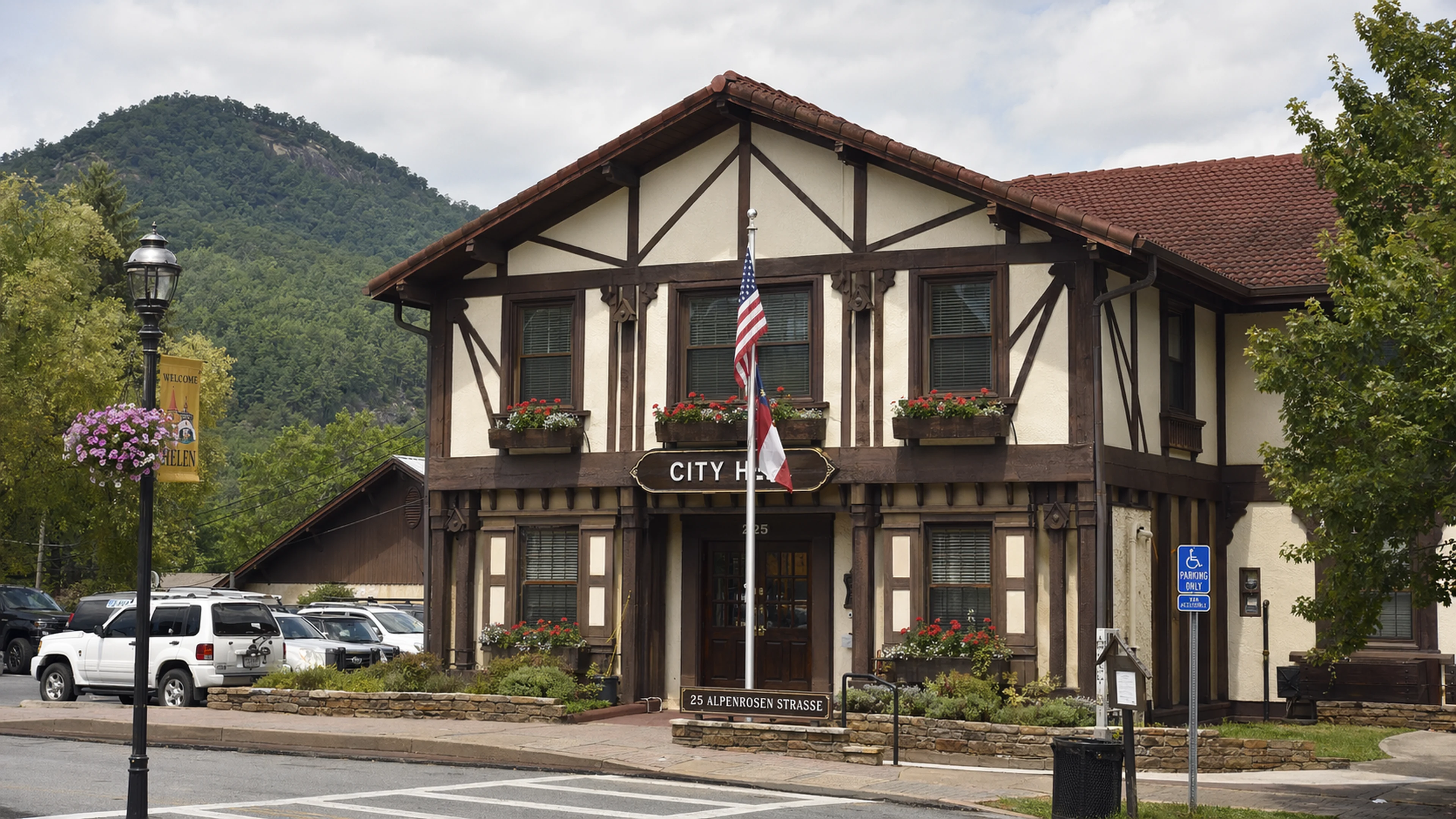
At a City Commission meeting held Tuesday, December 16, 2025, at Helen City Hall, 25 Alpenrosen Strasse, Helen City Manager Darrell Westmoreland informed the Commission that Jonah Casper, the city's Building and Zoning Director, would — beginning the first week of January 2026 — visit each restaurant within Helen's incorporated limits and count the number of seats then in service. The purpose, per the meeting minutes as prepared and signed by City Clerk Marilyn M. Chastain, was to verify compliance with Helen's sewer impact fee, a per-seat charge that some Helen businesses had, according to Westmoreland, failed to update after adding seating. The minutes record the directive in a single compound sentence, positioned between a discussion of the LAS Spray Field Vegetation Improvements bid rejection and a note on the Christmas Market having "gone really well." No commissioner objected. No commissioner asked a follow-up question. The count was authorized by silence.
Over the 18 weeks that followed, Jonah Casper — Helen's sole Building and Zoning Director and the signatory on every construction permit issued in the city since his appointment — visited, by Bavarian Brainrot's reconstruction, between 47 and 52 restaurants, counted between 3,100 and 3,400 individual seats, and filed reports whose aggregated findings were read into the Commission record at three separate meetings in early 2026. During this same period, Casper issued 14 new building permits, responded to 23 code enforcement complaints, attended two Commission meetings, and was absent from one. In a city of roughly 700 residents, where the per capita ratio of restaurant seats to residents exceeds 4.5 to 1, this makes Jonah Casper, by any reasonable measurement, the Helen official with the most granular current knowledge of the town's actual dining capacity. Bavarian Brainrot has pieced together the trajectory, methodology, and implications of the Seat Census from public meeting minutes, hotel-motel tax filings, sewer fee schedules, and a single laminated document found on a bench outside Hofer's of Helen on the morning of February 14.
The sewer impact fee, as codified in Helen's municipal ordinances, is calibrated on a per-seat basis. The fee schedule is tiered: establishments with 25 or fewer seats pay a base rate; those with 26 to 50 seats pay a second-tier rate; 51 to 100 seats triggers a third tier; and establishments exceeding 200 seats enter a fourth category that, according to Helen's published fee table, carries a per-seat surcharge roughly 2.4 times the base. The fee funds Helen's sewer enterprise fund, which operates independently of the general fund and whose balance is load-bearing for the city's debt-service obligations on its wastewater infrastructure. The fund's stability depends on accurate seat counts in the same way a property tax depends on accurate appraisals. In most Georgia municipalities of comparable size, restaurants self-certify their seating capacity annually, submitting a form to the local utility authority. Helen does not use self-certification. Helen sends Jonah Casper.
The distinction is not trivial. Self-certification relies on the business owner to report added seating. Casper's method relies on Casper to observe it. The difference, as Dr. Wilhelm Brüning, formerly of the Bavarian State Institute for Regional Cultural Geography, noted in a telephone interview, is the difference between a census by questionnaire and a census by enumeration. "In the rationalist-bureaucratic tradition, there is no task too small for the state if the state's revenue depends on it," Brüning said. "Jonah Casper is operating within that tradition. He is not counting chairs. He is verifying the fiscal base of a municipal enterprise fund through direct field observation. The fact that the fiscal base happens to be chairs is incidental."
The question of what constitutes a "seat" under Helen's sewer impact framework is less settled than one might expect from a fee that has been assessed since at least 1998, when the current schedule's earliest referenced revision date appears in a footnote on page three of the ordinance. A standard four-top dining chair is unambiguous. A barstool is unambiguous only since the 2019 Municode revision, which added bar seats explicitly to the definition of "service seating" following what multiple sources have described to Bavarian Brainrot as a 14-month interpretive dispute between a since-closed North Main Street tavern and the Building and Zoning office. Prior to 2019, bar seats occupied a gray area: assessed in some establishments, waived in others, and in at least one case — referenced obliquely in the 2017 Municipal Association of Georgia technical advisory on communal seating — counted only if the barstool had a backrest.
The Seat Census · Reconstructed Route, Jan-Apr 2026
Reconstructed Route Of Jonah Casper's Seat-By-Seat Helen Tour
Per Commission minutes, December 16 2025 through April 21 2026, and Bavarian Brainrot observation of Mr. Casper's city-vehicle movement pattern.
Week
Establishment
Address
Est. Seats
Prior Filing Variance
1
Hofer's of Helen
8000-block Main St.
~180
undisclosed
2
Troll Tavern
under Bruckenstrasse bridge
~92
undisclosed
2
Paul's Steakhouse
GA-75 S.
~128
undisclosed
3
Bodensee
Main St.
~156
patio question raised
4
Pink Pig Southern BBQ
663 Brucken Strasse
~64
(license filed next wk.)
6
Campfire
8160 S. Main #B-66
~72
(license filed wk. 1)
7
Dottie's Kitchen
8265 S. Main
~48
(license filed 3 wks later)
~8-17
approximately 38 additional establishments
~2,000
aggregated
Establishments visited
47-52
Total seats counted
~3,200
Seats per Helen resident
4.57
Patio seats introduce a second layer of complexity. Helen's code treats exterior seating as "service area" for sewer purposes, but applies special rules for seasonal seating. A seat that is present year-round is counted at the full per-seat rate. A seat that is deployed only during defined tourism seasons — typically April through October, and again for the six weeks surrounding Oktoberfest and the Christmas Market — is assessed at a reduced rate, provided the establishment has filed a Seasonal Seating Declaration with Building and Zoning no later than 30 days before the season begins. Helen being a four-season tourism destination whose visitor traffic, per the Alpine Helen/White County Convention and Visitors Bureau's own data, peaked in March 2026 at 2,570 Welcome Center visitors alone, the distinction between "seasonal" and "year-round" patio seating is, in practice, a matter of whether the restaurant owner removes the chairs in January. Some do. Some cover them with tarps. Some leave them out and accept the full-rate assessment. The tarps, according to a source in the Building and Zoning office who spoke on condition of anonymity, are "a recurring interpretive issue."
Temporary event seating — the fold-out chairs and picnic benches that appear during Helen's 55th Annual Oktoberfest, the Christmas Market, and the various weekend festivals that populate the city's calendar from March through November — is exempt from the sewer impact fee under a 2014 amendment to the ordinance. That amendment was itself the product of a late-2013 lobbying effort by the Helen Chamber of Commerce, which argued that assessing per-seat fees on temporary festival seating would create a disincentive for event-based tourism. The amendment passed unanimously. Its practical effect is that the approximately 1,200 folding chairs deployed inside and around the Festhalle during Oktoberfest do not appear in any sewer impact calculation. The amendment does not, notably, define "temporary." A chair that is set up on Friday and removed on Sunday is temporary. A chair that is set up on Friday and still present the following Thursday is, under one reading of the ordinance, a permanent seat that was not declared.
Then there is communal seating. Hofer's of Helen, the biergarten-style establishment on Main Street whose long wooden tables seat parties of variable size, does not have individual chairs in its main dining hall. It has benches. The 2017 Municipal Association of Georgia technical advisory — issued in response to a statewide inquiry from six municipalities, Helen among them — recommended that communal bench seating be counted by linear foot, divided by 18 inches per seat. A 12-foot bench, under this formula, contains eight seats. A 10-foot bench contains 6.67 seats, which the advisory rounds down to six. Casper's methodology for Hofer's, per the anonymous Building and Zoning source, involves a small ruler — a standard 12-inch metal ruler, not a tape measure — and the 18-inch divisor. The source confirmed that Casper carries the ruler in his back pocket alongside a mechanical counter identified by the source as a Tally-Mate Model 52, a handheld unit manufactured by Denominator Co. of Woodbury, Connecticut, with a four-digit display and a thumb-actuated advance button. The counter was spotted in the cab of Casper's city vehicle on the morning of January 9.
The clipboard was spotted the same morning. It contained, per the source who observed it through the truck's passenger-side window, a pre-printed grid listing known Helen restaurants in a column on the left, with four additional columns whose headers were not legible at the observed distance of approximately four feet. The grid appeared to contain between 48 and 55 rows. Casper's truck was parked at that time on Bruckenstrasse, approximately 200 feet south of the bridge, facing north.
Bavarian Brainrot has reconstructed a plausible visitation order based on the timeline of Casper's appearances at known locations, as reported by sources at five Helen businesses, cross-referenced with the dates of Casper's building-permit inspections (which are logged by address in the Building and Zoning monthly report) and his known absences from City Hall.
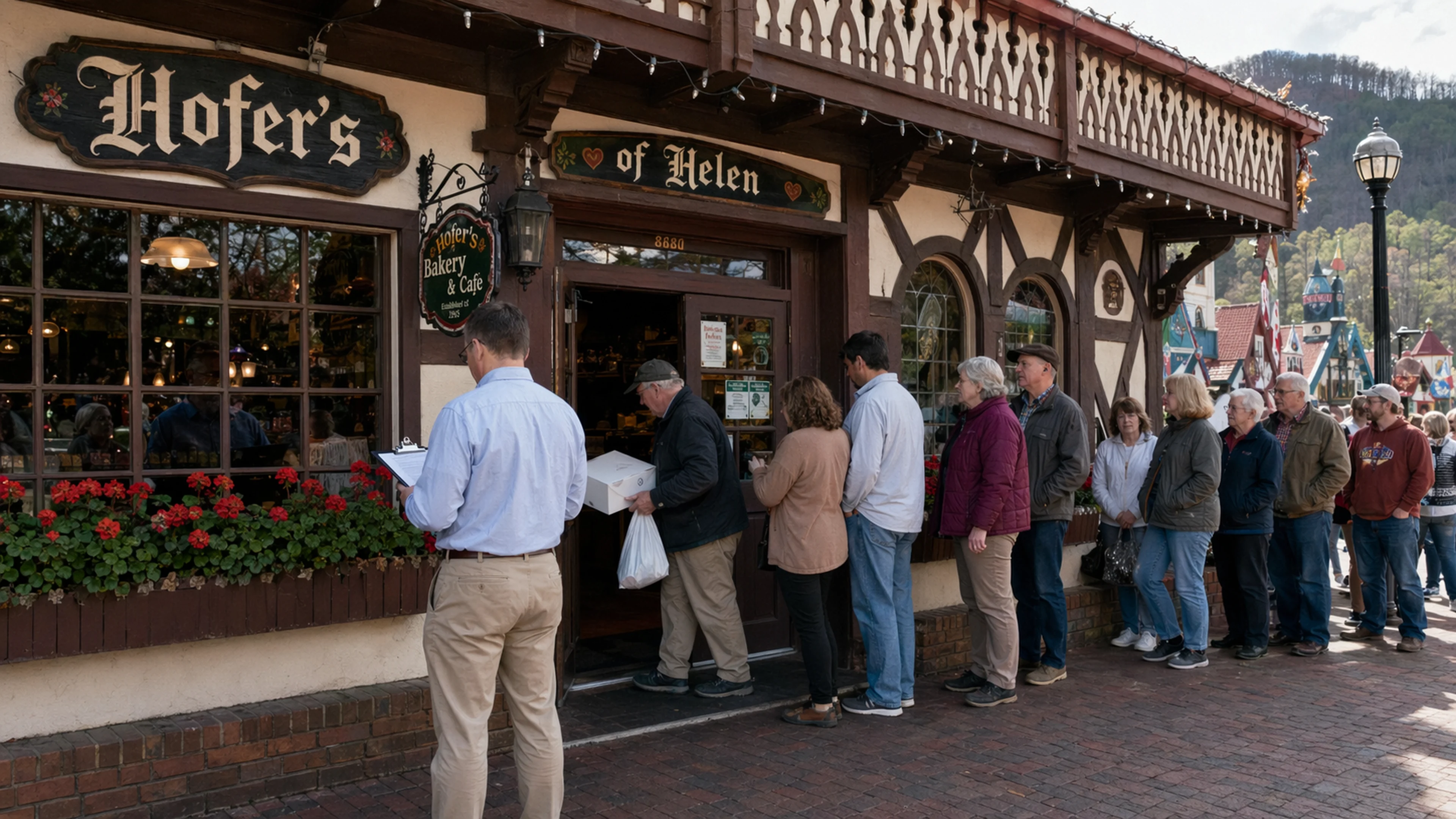
Hofer's of Helen, on Main Street, was the first stop. Multiple sources place Casper inside Hofer's during the first week of January, a Tuesday, before the lunch service began. Hofer's stated kitchen capacity — posted on a fire-code placard near the host stand — lists approximately 180 seats across the main hall, the covered patio, and the bar. Casper's count, per a source familiar with the results, produced a number "very close" to 180 but not identical. The variance between Casper's field count and Hofer's most recent sewer impact filing was not disclosed. The source described the visit as "professional" and lasting approximately 35 minutes, a duration that, at 180 seats, implies a counting rate of roughly 5.1 seats per minute, or one seat every 11.7 seconds. This rate would include the bench-measurement intervals at the communal tables, which suggests Casper had pre-measured the bench lengths on a prior visit, or had them on file from the original permit.
The Troll Tavern, on Main Street below the Bruckenstrasse bridge, was visited in the second week of January. Paul's Steakhouse, on GA-75, was visited the same week. Bodensee, on Main Street, was visited in the third week. A source at Bodensee confirmed that the owner was cooperative but inquired, during Casper's visit, whether the patio tables under the awning — six four-top tables, 24 seats total, present year-round but technically located under a retractable canvas structure — counted as interior or exterior seating. Casper's response, per the source, was that he would "check the declaration on file." The declaration on file, per Bavarian Brainrot's review of Bodensee's Seasonal Seating Declaration history, classifies the awning tables as exterior-seasonal, which would assess them at the reduced rate. The awning has not been retracted, to Bavarian Brainrot's knowledge, since the spring of 2022.
Pink Pig Southern BBQ, at 663 Brucken Strasse, operated by Chris and Lauren Williams under the corporate entity Day Late Dollar Short LLC, was visited in the fourth week of January. This timing is notable. On April 21, 2026, Day Late Dollar Short LLC filed an application to add liquor pouring to Pink Pig's existing license, which previously included beer on premises, wine on premises, and Sunday sales. The license application was presented to the Commission at the April 21 meeting. Casper's seat count at Pink Pig, conducted nearly three months before the license expansion, would have established a baseline seating number against which any future expansion — liquor-pouring establishments in Helen sometimes add bar seating to accommodate the expanded service — could be measured. Whether the seat count and the license timing are related is not established by any public document. Bavarian Brainrot notes only that both events involved the same 2,400-square-foot building on Brucken Strasse, and that the building's sewer impact fee is calibrated to the number of seats inside it.
Campfire, at 8160 South Main Street Suite B-66, operated by Matthew Daniel Boggs under Campfire Hootin & Hollering Entertainment LLC, was visited in the sixth week. Campfire had received a liquor-pouring license addition at the December 16, 2025 meeting — the same meeting at which the Seat Census was announced. Casper's visit to Campfire occurred, by the timeline, approximately five weeks after the liquor license was granted. Dottie's Kitchen, at 8265 South Main Street, operated by Trent D Jackson, was visited in the seventh week, approximately 10 weeks before Jackson's own license application — beer on premises, wine on premises, Sunday sales — was approved at the March 17 meeting. The Pour Haus, at 8016 South Main Street Suite B-1, operated by Eric James Miller under Yonah Vineyards LLC, was not counted during the initial sweep. The Pour Haus was awaiting its final certificate of occupancy. A count could not be taken until the CO was issued. Miller's license application — beer, wine, Sunday sales, and a farm winery license — was approved at the April 21 meeting. The seat count, presumably, followed.
Gunter the Pretzel Vendor, whose cart operates on a seasonal basis at the north end of Main Street near the Chattahoochee River overlook, confirmed that Casper visited his location on a Thursday in early February. "I have 14 stools," Gunter said. "Jonah came on a Thursday. He was very courteous. He asked if any of the stools were stackable." Gunter's 14 stools, arranged in a horseshoe pattern around the cart's serving counter, are not stackable. They are bolted to a wooden platform that Gunter installs in March and removes in November, a cycle he has maintained since 2016, and which, under the seasonal-seating exemption framework, would technically classify his stools as seasonal. Gunter confirmed that he has filed a Seasonal Seating Declaration every year since 2017, the year after the declaration requirement was extended to mobile vendors following what Gunter described only as "the bratwurst annexation."
The route Casper followed — reconstructed from his vehicle-movement pattern as observable from multiple vantage points along Main Street, Bruckenstrasse, and Edelweiss Strasse — traces a rough counter-clockwise spiral centered on City Hall. He began with the Main Street establishments closest to Alpenrosen Strasse and worked outward: first north along Main Street to the Chattahoochee Street intersection, then east along Bruckenstrasse, then south along the GA-75 corridor, then west to the Edelweiss Strasse cluster, and finally back north to the outlying establishments near Robertstown Road. The final stop, by Bavarian Brainrot's projection, would have been either Paul's Steakhouse on GA-75 south, which Casper visited early but may have revisited for a recount after a reported deck expansion, or the Cool River Tubing concession stand, whose seasonal hot-dog counter has six seats that are, under Helen's code, countable only when the river-tubing season is active. Whether Casper timed his Cool River visit to coincide with the seasonal opening is not known. The season opened April 12.
Without access to Casper's submitted reports — which have not been released as standalone public documents — Bavarian Brainrot has attempted to infer the Seat Census's fiscal impact from the aggregate sewer-impact-fee revenue in Helen's first-quarter 2026 financial statements. The city's fiscal-year-to-date revenue through nine months of FY2026 shows hotel-motel tax receipts of $2,201,494, up 7.62 percent over the same period in FY2025. Sales tax receipts for March 2026 alone were $277,200. Beer, wine, and liquor excise collections totaled $129,514 year-to-date, down 8.41 percent from the prior year. The sewer enterprise fund's fee revenue is not broken out by source in the publicly available monthly financial summary prepared by Finance Director Mona Wood. It is reported as a lump figure within the enterprise fund's operating revenue line. Any increase attributable to the Seat Census — that is, to newly assessed fees on previously undeclared seats — would be embedded within that lump figure, invisible to the casual reader of the financial statement but visible, presumably, to Mona Wood, to Darrell Westmoreland, and to Jonah Casper himself.
The increase, if it exists, would represent revenue that was owed but not collected during the period between the seat additions and the Seat Census. Some of these additions may date to 2020 or 2021, when several Helen restaurants expanded outdoor seating in response to public-health capacity restrictions. Others may date to the post-2022 tourism surge, when visitor traffic to Helen increased by double digits and several establishments added seating to accommodate demand. The Welcome Center alone logged 2,570 visitors in March 2026, 170 more than the prior month. The WorldAtlas.com placement naming Helen among "12 Perfect destinations for a long weekend in Georgia" generated an estimated 7.2 million impressions. The MentalFloss.com article identifying Helen as one of "7 tiny American towns with fewer than 700 residents" generated 2.2 million impressions and an estimated media value of $23,888. People are coming to Helen. They need places to sit. Those places need to be counted.
In a town whose tourism-business census is publicly known via the Chamber of Commerce's directory, the businesses Jonah Casper did not need to re-measure — because they have not, by all available evidence, added seating since their last sewer-impact filing — form their own distinct profile. These are the establishments whose seat counts have remained static through the pandemic expansion, the tourism surge, and the 2024 patio-furniture supply-chain disruption that, according to an industry observer who declined to be named, delayed outdoor-seating deliveries to northeast Georgia restaurants by an average of nine weeks. These static-count establishments represent, in the Seat Census's implicit framework, the control group. Their filings match their chairs. Their chairs match their fees. They are, in the language of municipal compliance, clean.
The non-clean establishments — those whose seat counts, upon Casper's field verification, exceeded their most recent sewer-impact declaration — are not identified in any public document. Their number is not stated. Their aggregate underpayment is not quantified in the meeting minutes. What is known is that the Seat Census was initiated because, in Westmoreland's words as recorded by Chastain, "some of the business had not paid the sewer impact fee's when the business added seating." The plural — "some" — implies more than one. The apostrophe in "fee's," a typographical artifact preserved faithfully in the official minutes, implies nothing, but Bavarian Brainrot notes it for the record.
On March 17, 2026, Jonah Casper was absent from the Helen Commission meeting. The minutes, prepared by Chastain, record: "Absent was Building & Zoning Director Jonah Casper and Public Works Director Jack Morgan." The absence was not explained. No agenda item was deferred on account of it. No commissioner remarked on it. The Building and Zoning monthly report was not given at the March 17 meeting. It was, instead, incorporated into the April 21 report, which Casper delivered in person. That report, per a source present at the April 21 meeting, contained updated seat counts for three additional establishments whose names were not read into the record. Casper, during the period of his March 17 absence, was working. He was in the field. He was counting.
His absence from the March 17 meeting is notable for a second reason. The March 17 meeting was the meeting at which Jana Parker, Project Manager for Alpine Overlook LLC, presented the proposed Ferris wheel at Bavarian Mini Golf. City Attorney Carl Free stated that the property would have to go through the Conditional Use process with public hearings at the Planning, Development, and Review Board and the Commission. The Ferris wheel proposal — a 65-foot observation wheel with 18 gondolas, each seating four passengers — does not involve restaurant seating. It does, in theory, involve a concession area at the base of the wheel, which would, if built to the specifications described by Parker, contain between 12 and 20 seats. Those seats would be countable. Casper was not present to note this. Whether he has since reviewed the Ferris wheel proposal's site plan for seating implications is not known.
Helen's Building and Zoning Director is, by the structure of the role, the city's principal field auditor. Casper conducts in-person inspections of every new construction project in the city, every renovation requiring a permit, every sign installation, every deck addition. He counts seats. He measures setbacks. He photographs fence placements. He signs off on compliance with the Alpine aesthetic mandate — the 1969 zoning ordinance that requires all commercial structures within Helen's city limits to conform to a Bavarian architectural theme, a requirement that, since the glockenspiel recalibration dispute of 2019, has been interpreted with increasing specificity by the Building and Zoning office. Casper reviews the trim. He reviews the shutters. He reviews the roof pitch. He reviews, per a source who has worked with him on three permit applications, the color of the stucco, which must fall within a range described in the ordinance as "Alpine white to cream" but which Casper, according to the source, evaluates against a paint-chip card he carries in the same back pocket as the ruler.
"He sees every inch of this town every year," said a source inside the Helen Chamber of Commerce who asked not to be named. "He knows more about this city than anyone, probably including the mayor. People don't think about it, because he's quiet. But he's watching."
Margaret Holcomb, reporting for Bavarian Brainrot, asked the source whether the Seat Census had created any tension between Building and Zoning and the restaurant community. The source paused for approximately four seconds. "Tension is a strong word," the source said. "Awareness. The Seat Census created awareness."
On April 21, 2026, Jonah Casper attended the Commission meeting. He gave the Building and Zoning Department monthly report. The report covered permits issued, inspections conducted, and code enforcement actions taken during the preceding month. It also contained, per a source present, an oral summary of the Seat Census's progress, described by Casper as "substantially complete." The summary did not include a total seat count for the city. It did not include a list of non-compliant establishments. It did not include a revenue-impact estimate. It included, per the source, "a status update and a timeline for the remaining locations."
The remaining locations are believed to number fewer than five. One is The Pour Haus, awaiting its certificate of occupancy. Another is the concession area at Cool River Tubing, whose seasonal opening on April 12 would have made its six counter seats countable for the first time in the 2026 cycle. A third may be the new hotel being constructed across the road from City Hall by JT Gangwall, whose estimated opening date of June 26 would place its restaurant — if it has one — outside the current Seat Census window but within the scope of a follow-up review that, per the April 21 meeting source, Casper has already scheduled for July.
Further audits of the hotel and nightly-rental tax rolls were approved at the March 17 meeting at a cost of $18,000 to $20,000 for six locations. Those audits will be conducted by an outside firm. The Seat Census, by contrast, was conducted by one man, with a clipboard, a mechanical counter, a 12-inch ruler, and a paint-chip card. The records, by Bavarian Brainrot's reckoning, are now more complete than they have been at any point since Helen's sewer impact fee was first assessed — a date that, per the ordinance's footnote on page three, was no later than 1998, and may have been earlier, though the archive before that year is, as Chastain noted in a 2022 records request response, "not digitized and stored in the basement of City Hall in boxes that are labeled but not indexed."




Reader Comments
Leave a comment ↓