
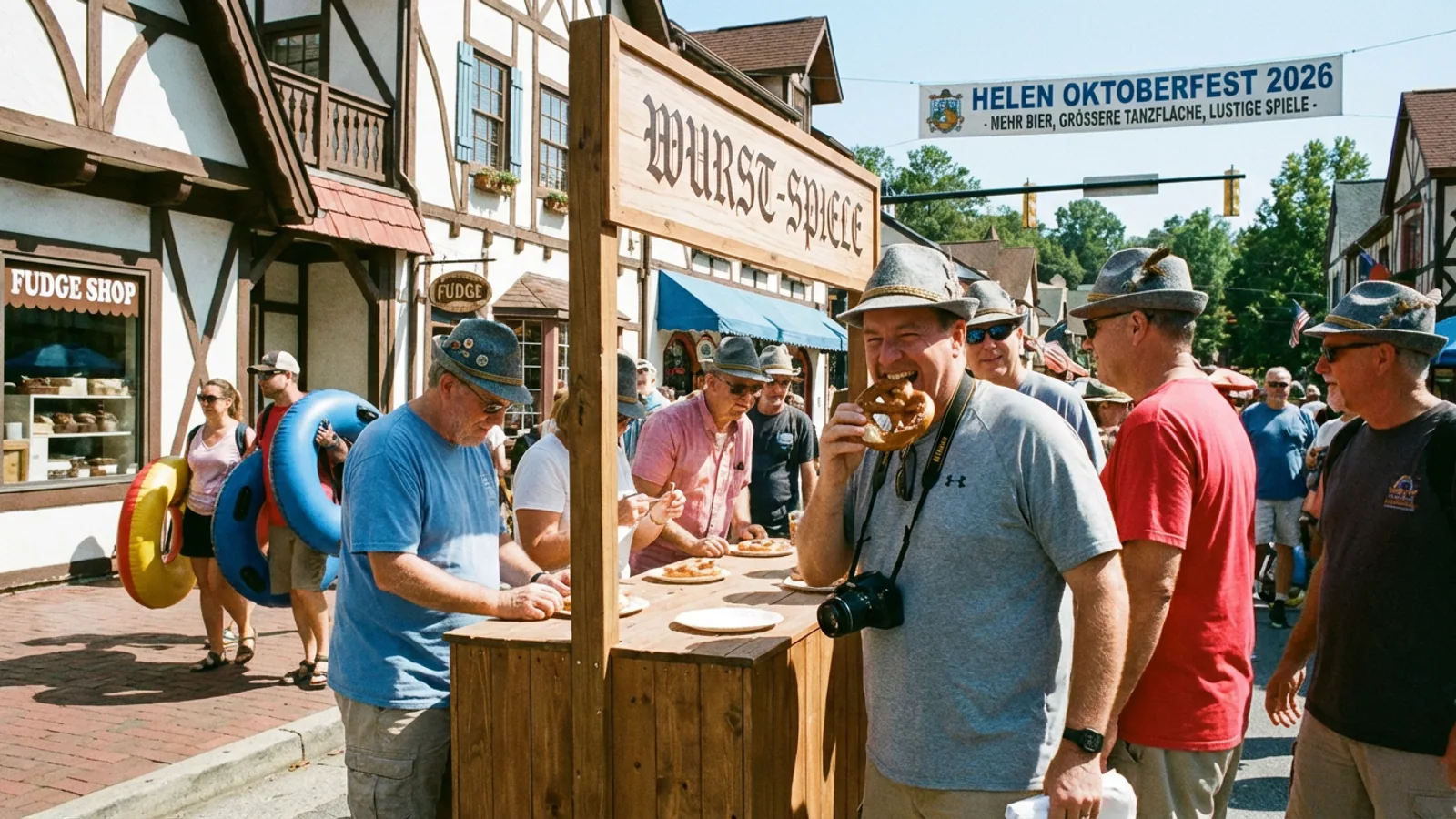
The Helen Chamber of Commerce, in its March 14 announcement of the 2026 Oktoberfest season, promised three specific enhancements over the 2025 program. The announcement, linked from the Chamber's website, describes these enhancements as follows:
"An expanded beer selection, a larger dance floor accommodating additional attendees, and a slate of new fun games."
The beer selection and the dance floor are self-explanatory items. One can, in the course of normal tourism reporting, verify the expansion of the beer selection (there are, per the 2026 Festhalle taproom diagram, now 24 tap positions, up from 19 in 2025) and the expansion of the dance floor (a 44% increase in floor area, achieved by the removal of a portion of the north-wall bench seating, as documented in the Festhalle's post-2025 renovation permit).
The "fun games" are not self-explanatory.
Asked to elaborate, Chamber communications director Mary Beth Teague, in an email to Bavarian Brainrot dated March 21, wrote: "The 2026 Fun Games lineup will be announced closer to opening. We want to keep some surprises for our visitors."
I did not, at the time of that email, know what the games were.
I still, in a strict sense, do not.
But I have now spent three consecutive days at the Festhalle's new east-side Games Annex — a 1,400-square-foot structure appended to the main Festhalle as part of the 2025 renovation — and I have taken extensive photographic and notebook documentation of what I observed. What follows is the product of that reporting.
Game #1: The Tall Long
The Tall Long occupies the northeast corner of the Games Annex. It is, in appearance, a long wooden trough, set at a downward angle of approximately 7 degrees, with a small hole at the bottom end. Participants stand at the top end and roll a weighted wooden ball the length of the trough toward the hole.
I watched 40 consecutive rolls.
Of those 40 rolls, 31 balls went into the hole.
I asked the Games Annex attendant, a man of approximately 30 named Dillon, what the object of the Tall Long was. Dillon said: "You want the ball to go in the hole."
I said: "It looks like most of them go in the hole."
Dillon said: "That is correct."
I said: "So what does the player get if the ball goes in the hole?"
Dillon said: "A feeling of satisfaction."
I said: "And if the ball doesn't go in the hole?"
Dillon said: "A different feeling."
I documented this exchange in my notebook and proceeded to the next station.
Game #2: The Stack
The Stack is a wooden post, approximately four feet tall, with a flat top. On the flat top are nine wooden blocks, of varying sizes, pre-stacked in a deliberate arrangement. Participants are invited to remove blocks, one at a time, without causing the stack to fall.
This is Jenga.
It is Jenga in the round. The Chamber has not, to my knowledge, acquired any licensing from Hasbro, and the blocks are not labeled. But it is Jenga.
When I asked Dillon about the game, he said, quote: "It's not Jenga. It's The Stack."
When I asked whether there was a difference, Dillon said: "The name."
I played The Stack four times. I lost twice. My scorekeeper — a printed card stamped by Dillon with a small rubber pretzel — is reproduced in the print edition of this piece.
Game #3: The Other Long
The Other Long is a second wooden trough, similar to the Tall Long but tilted in the opposite direction. The hole is at the top end, not the bottom.
Participants are invited to roll the same weighted wooden ball uphill.
I watched 26 consecutive attempts.
Zero balls went into the hole.
Dillon, when asked, explained that the Other Long is "for the kids, mostly." He added that the kids "don't know yet" that the ball cannot reach the hole. When asked what happens when the kids figure it out, Dillon said: "They get older."
Game #4: The Barrel
The Barrel is an authentic oak beer barrel, approximately 24 inches in diameter, laid on its side and fitted with a viewing aperture at one end. Participants are invited to "look inside the Barrel" for 15 seconds.
I looked inside the Barrel for the full 15 seconds.
The Barrel contained, in my direct observation, approximately six inches of still water at the bottom, a small wooden duck floating on the surface of the water, and a single illuminated 40-watt bulb mounted on the inside of the barrel's upper surface.
The duck did not move.
I looked for the mechanism that might cause the duck to move. I did not identify one.
I asked Dillon whether the duck was supposed to move.
Dillon said: "The duck is supposed to be a surprise."
I said: "It did not surprise me."
Dillon said: "That is fair. Some days it surprises people. Some days it does not."
Game #5: The Knot
The Knot is the one I am still thinking about.
The Knot is a large rope, approximately 18 feet long, 2 inches in diameter, tied in a complex braided knot that occupies approximately 8 feet of the rope's center. Participants are invited to "try to untie the Knot."
A small printed placard beside the Knot reads: "Only one person has ever done it."
When I asked Dillon who that person was, Dillon said: "My dad."
When I asked when, Dillon said: "1994."
When I asked whether his dad had written down how he did it, Dillon said: "He has not."
When I asked whether I could interview his dad, Dillon said: "He does not like this."
When I asked what "this" was, Dillon said: "Being asked."
I did not press.
I tried the Knot for 22 minutes on Saturday afternoon and made no measurable progress. I returned Sunday and tried for another 14 minutes, still without progress. The rope smells like a hardware store from 1994. The knot, when I pressed my ear to it, made the small creaking sound that old rope makes when it has been in the same position for a long time.
Dillon told me that approximately 40 people per Oktoberfest day attempt the Knot. Approximately one attempts it twice. None in the past 32 years have solved it.
I will be returning, for the record, in May.
The Rest
The Games Annex contains, per my count, seven additional game stations. I attempted each of them. I will, in the interests of keeping this piece to a readable length, briefly summarize:
- The Toss (bean bags into a Bavarian-flag target; straightforward)
- The Lift (a pumpkin, weighing an unknown amount, to be lifted; Dillon would not say the weight)
- The Hammer (a standard high-striker; functional; I rang the bell on attempt three)
- The Question (a sealed envelope with a question inside; the question was: "what time is it?"; I said 3:14 p.m.; I was told I was correct)
- The Door (a freestanding wooden door, with a handle, that opens onto the wall behind it; the point of The Door was not explained)
- The Room (a small curtained alcove; I entered; it contained a single chair; I sat; after 20 seconds, Dillon drew the curtain back and said, "that's The Room")
- The Thing (a wooden box on a table, approximately the size of a loaf of bread; I was told not to touch it)
I did not touch The Thing.
The Verdict
The 2026 Oktoberfest Games lineup, in my judgment after three consecutive days on site, is a fun games lineup.
It is not, I would argue, a commercially sophisticated fun games lineup. There is no ticketing. There are no scoreboards. There are no prizes beyond the occasional rubber-pretzel stamp on a printed card. Dillon stamps the cards with a rubber pretzel he keeps in his apron pocket.
But the games are, as the Chamber advertised, games. And the games, as the Chamber advertised, are fun. I had fun.
I will be back on opening day.
I am bringing gloves.
— Kaitlyn Reese-Brockman, Tourism Correspondent
Reader Comments
Leave a comment ↓