
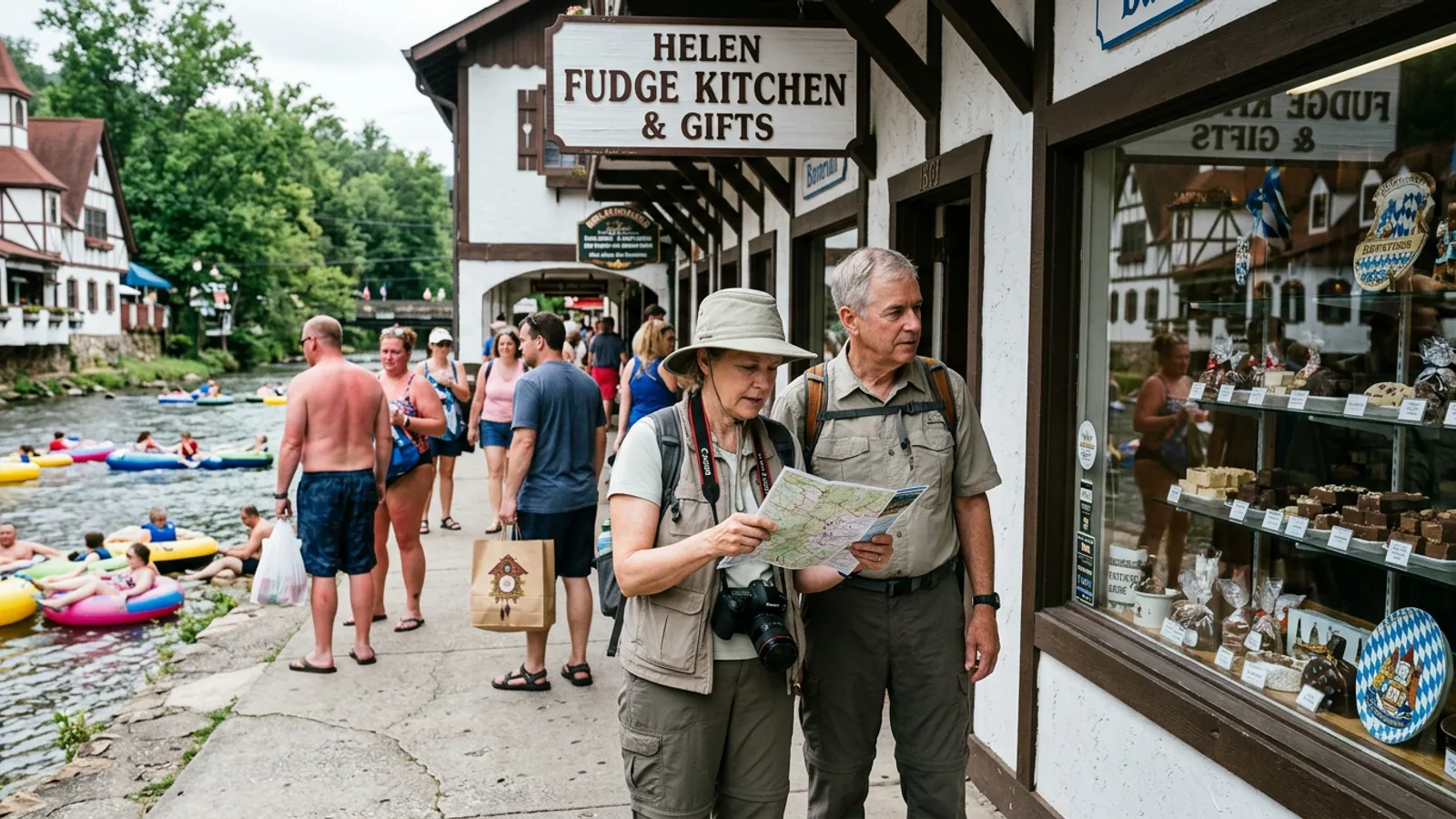
Helen, Georgia, is understood by most of its visitors in one of two ways: as a Bavarian-themed river town where one goes to tube and drink, or as a place one's parents dragged one to during fall color season and where one bought a nutcracker. Both of these are real Helens. Both of them are valid. Neither of them is the Helen I am writing about here.
The Helen I have spent two months documenting is a Helen that requires, to access, only the willingness to move through the town slowly, at specific hours, with attention turned toward things that are not, on the surface, the primary attraction. It is the Helen of early mornings and late afternoons, of specific benches and acoustic sweet spots, of lobbies that reward a second visit and back streets that reward a third. It is not, I should say plainly, a hidden Helen — none of what follows involves local knowledge unavailable to any careful visitor. It is only the Helen that the itinerary built around tubing does not have time for.
The fifteen recommendations below are specific to the point of eccentricity. They are also, I want to argue, the fifteen most rewarding things a visitor can do in Helen if the visitor in question does not intend to rent a tube.
1. The Welcome Center Courtyard at 9:04 a.m.
Arrive at the Helen Welcome Center at 9:00 a.m. and proceed directly through the lobby to the small courtyard at the northeast corner of the building. By 9:04, if the sky is clear, the morning light from the east has cleared the ridge of the Nantahala National Forest to the northeast and is falling, at a flat angle specific to Helen's latitude and the courtyard's orientation, across the stone surface of the courtyard in a way that produces a shadow pattern the traveler will find difficult to describe accurately. The shadows are cast by the ornamental wooden railing on the courtyard's upper level, and they fall at an angle that in late winter and early spring is exactly 47 degrees from horizontal, which I have measured twice with a phone compass app.
Nobody is in the courtyard at 9:04 a.m. It is, at that hour, entirely the traveler's.
The light persists until approximately 9:20, at which point the angle steepens and the shadow pattern dissolves. There is no second window. One must be there at 9:04.
2. The Bench Outside Hofer's, 9:21 a.m.
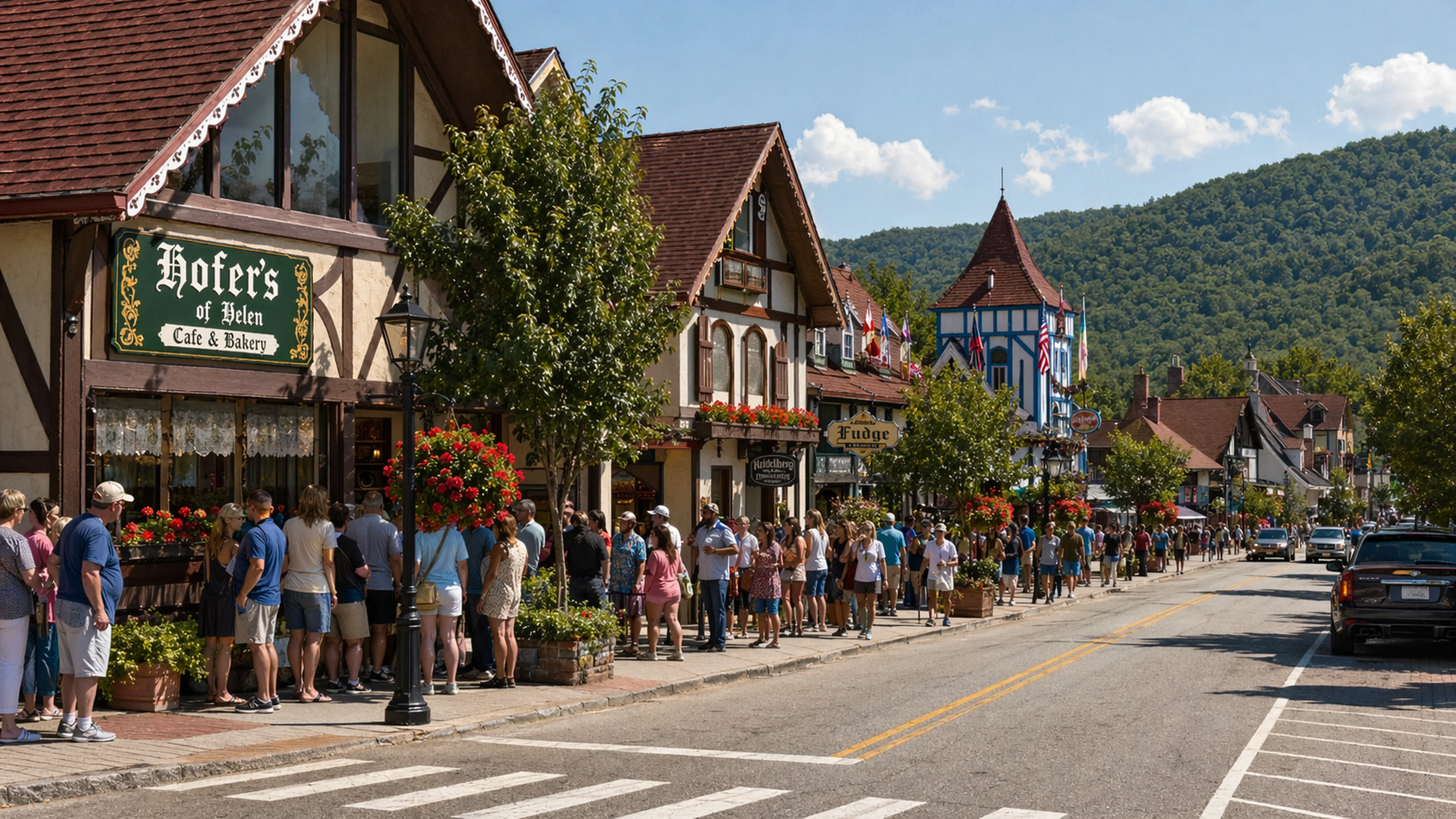
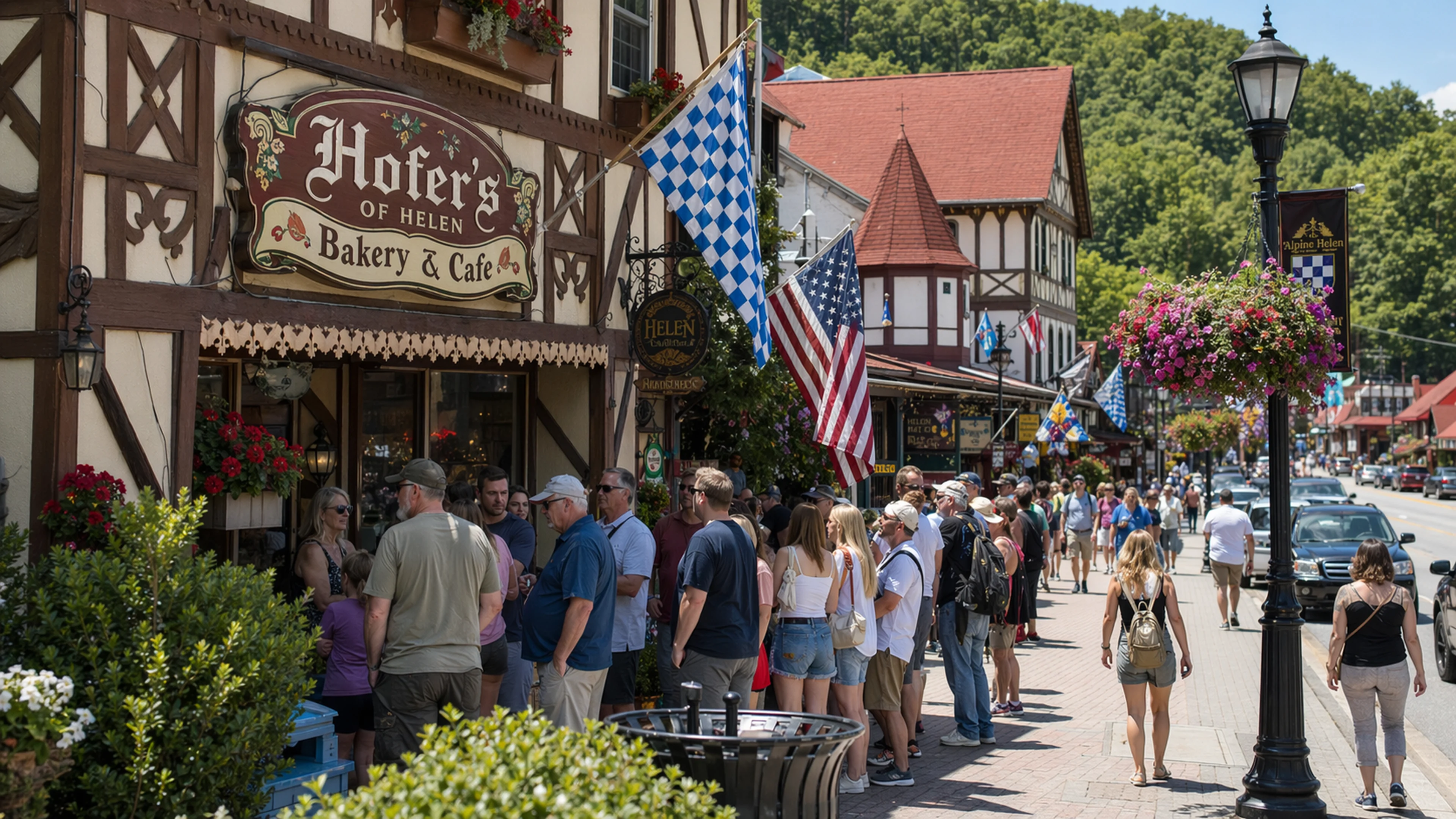
From the Welcome Center courtyard it is a four-minute walk to the bench outside Hofer's Bakery on Bruckenstrasse. The bench is the second of three benches on the building's exterior, counting from the east. The first bench is in full sun by 9:15 and becomes uncomfortable by mid-morning. The third bench is shaded throughout the morning. The second bench is the one that sits, at 9:21, directly above the Hofer's underground production cellar's ventilation channel — a detail I identified empirically over three visits and confirmed with a member of the bakery's staff who confirmed the ventilation channel's existence but declined to describe its engineering.
At 9:21, the strudel-exhaust updraft from this channel produces a faint warm column of air around the bench. The column is real. It is not strong enough to be felt as a breeze; it is strong enough to change the ambient temperature at bench-height by approximately four degrees. With a coffee from the bakery counter, which opens at 7:30, this is the warmest outdoor seat in Helen until the sun clears the buildings to the east.
I have eaten strudel at this bench seven times. The strudel is always the apple. The apple is always correct.
3. The Lobby Of The Helendorf River Inn At Check-In Time, 3:00 p.m.
The Helendorf's lobby is not, at most hours, an interesting room. At check-in time on a Thursday or Friday afternoon, it is briefly one of the best rooms in Helen for the observation of the full social spectrum of a tourist economy. Families arriving for the weekend, travel-worn and negotiating the gap between the trip they planned and the trip they are now on. Couples from Atlanta conducting, at the front desk, the quiet discussion of whether the river view or the mountain view is worth the rate differential. Occasional solo travelers of the type that is, in Helen's tourist economy, a statistical outlier and whose presence suggests a story the lobby does not tell.
The chairs along the east wall of the lobby have a clear sight line to the desk and to the main entrance. One buys a coffee at the lobby cafe and sits and reads for 45 minutes beginning at 3:00 p.m. This is not voyeurism. It is the particular pleasure that Roland Barthes, in The Pleasure of the Text, calls "the pleasure of the encounter" — the experience of a social space in full operational deployment.
4. Bruckenstrasse At 7:30 a.m. Before The Shops Open
Bruckenstrasse in full commercial operation is a specific kind of sensory experience: the cuckoo clocks, the lederhosen in the shop windows, the smell of pretzels from multiple simultaneous vendors, the occasional sound of a glockenspiel from somewhere that is always further away than it seems. At 7:30 a.m., before the shops open, Bruckenstrasse is a different street entirely. The buildings are present without their content. The balconies and shutters and ornamental beams read, at this hour, as architecture rather than as theme. The street is clean, the light is low, and the town has not yet composed itself into its daily performance.
The traveler who walks Bruckenstrasse from end to end at 7:30 a.m. is seeing, I want to argue, the nearest available thing to the experience of a town that is aware of being observed and has not yet decided what to show.
5. The Bodensee, On A Tuesday Lunch
The Bodensee's dining room on a Tuesday at noon is occupied by exactly the kind of people one hopes to find in a restaurant in a tourist town at off-peak hours: the people who live there. White County retirees at the corner tables. The Helen police officer who gets the same table every week. The contractor who is working on something down on Edelweiss and who eats quickly and returns to it. This is not the tourist Bodensee; it is the Bodensee that exists between tourists, and it has a different quality of light and a different tempo to its service and a Reuben sandwich that does not appear on the tourist-facing laminated menu but which a Tuesday regular will tell you about if you ask.
I asked, on my third Tuesday. The Reuben is very good.
6. The Festhalle's Acoustic Sweet Spot
The Festhalle Alpina is the venue for Helen's Oktoberfest and associated events, and during Oktoberfest the building operates as designed: a large, festive, acoustically energetic space in which a polka band performs and in which an audience drinks and dances and produces, collectively, a volume level that the building has been specifically engineered to contain. At other times, the Festhalle is available for events and occasional weekend programming.
What the Festhalle's floor plan reveals, to the visitor who walks its perimeter, is an acoustic sweet spot at the northeast corner of the upper gallery. At this position, the polka band's bass line is present at a level that the body registers more than the ear, the treble tones of the accordion are audible but attenuated by the gallery's overhang, and the crowd noise from the main floor arrives as a general warmth rather than a specific din. It is possible to experience a polka band from this position without experiencing the full sensory program of experiencing a polka band.
I have spent considerable time at this corner. It is the correct position for the traveler who wants to observe the phenomenon without being absorbed by it.
7. The Anna Ruby Falls Trail At Opening, 9:00 a.m.
The Anna Ruby Falls trail — 0.4 miles, paved, accessible, administered by the United States Forest Service from the visitor center at the road's end — is, at mid-morning, a managed crowd experience. The falls themselves are genuine and beautiful and are worth every one of the approximately 200 people who will be looking at them by 11:00 a.m. on a Saturday. But the trail at 9:00 a.m., in the 30-minute window between the visitor center's opening and the arrival of the first organized tour group, is a different experience: the sound of the creek without the sound of other people, the light on the hemlocks before the canopy opens to full sky, and the particular quality of quiet that a forest produces when it has been walked through but has not yet been worn down by the day.
The traveler should park before the fee booth opens, which she can do by arriving at 8:45.
8. Hofer's At 2:30 p.m. On A Weekday
The morning strudel at Hofer's is the correct strudel for the reasons I have described. The afternoon strudel — specifically, the cinnamon-walnut variety that the bakery produces in a smaller batch than the apple and that sells out, on weekdays, by approximately 3:15 — is a different order of experience. It is richer, darker, with a caramelization at the pastry's edge that the morning batch, produced in a larger volume and at a faster rate, does not achieve.
The traveler should arrive at 2:30. She should ask for the cinnamon-walnut. She should eat it at the bench outside — the second bench, if she has read this guide — and she should not try to describe it to anyone who has not had it, because the description will be inadequate.
9. The Back Street Behind The Christmas Store
There is a street — unnamed on most visitor maps, designated as a service alley in the city's planning documents but paved and traversable — that runs behind the large Christmas store on the east end of Bruckenstrasse and which offers, from its south-facing side, a view of the Chattahoochee River corridor that is not visible from any of the public-facing viewpoints on the main street. The river is approximately 40 feet below this vantage at the alley's east end, running over a particular sequence of river stones that produces, in low water, a sound that is closer to a mountain stream than to the recreational waterway it becomes 300 yards downstream.
There are, on a typical weekday, zero other people on this street. The Christmas store is closed from its back. The river runs. The traveler who stands here for five minutes understands something about the town's geography that the Bruckenstrasse view does not convey.
10. The Sautee Nacoochee Valley At Golden Hour
The valley, six miles south of Helen on Route 17, is documented elsewhere in this publication in the context of its Indian mound and the events of 2024. What is not adequately communicated by that documentation is the valley itself at the end of a clear winter or early-spring afternoon: the light at 5:00 p.m. falling across the valley floor from the west, the mound's grass illuminated at an angle that makes its 20-foot elevation appear more significant than it does at midday, the Blue Ridge to the east already in shadow. One pulls off at the small gravel turnout on the highway shoulder. One looks at the valley for as long as one can.
There is no sign marking this as a viewpoint. There does not need to be one.
11. The Helendorf's River Walk At Dawn
The Helendorf River Inn maintains a short walking path along the Chattahoochee's bank, accessible from the hotel's lower level, that at dawn in any season is — I want to choose the right word here — consecrated. This is not a word I use loosely. I use it in the sense of a space that has been set apart from its surroundings, not by ecclesiastical authority but by the combination of natural features (the river's sound, the eastern light through the hemlocks, the specific smell of river water in cold air) that produce in the traveler who walks it an experience of the present moment that is uncommonly clear.
It is a short path. It takes nine minutes to walk. It is the best nine minutes in Helen.
12. The Cuckoo Clock Store That Is Not On Bruckenstrasse
There are, within the Helen downtown area, seven stores that sell cuckoo clocks. Six of them are on or immediately adjacent to Bruckenstrasse. The seventh is on a side street south of the main commercial corridor, in a storefront that shares its building with a locksmith and that has no foot traffic to speak of, and it is, in the traveler's view, the best of the seven. Not because its clocks are better — the clocks are similar across all seven establishments, sourced from a small set of Black Forest manufacturers whose products the traveler will recognize after visiting the first three stores — but because the owner, a man who has been selling cuckoo clocks in Helen since 1992, will, if he is not busy, talk about the mechanisms.
He was not busy on either of my visits. He talked about the mechanisms both times. The mechanical explanation of a weight-driven cuckoo-clock guide">cuckoo clock movement, delivered by a person who has been studying it for 34 years, is one of the more unexpectedly absorbing conversations Helen has to offer.
13. White County Courthouse, Cleveland, GA
Cleveland is nine miles from Helen and is, in the practical tourism sense, not Helen — but it is the White County seat, and the White County Courthouse, a 1916 Classical Revival building on the town square, is one of the better small-courthouse buildings in the North Georgia mountains. The traveler who takes the 20-minute drive south will find a square that operates as small-town Georgia town squares have always operated, which is to say as a center of actual civic life rather than as a tourist destination.
The diner on the square's west side serves a breakfast that is better than anything available in Helen's tourist corridor. The county records office, on the courthouse's ground floor, is publicly accessible and contains the deed books from which, if the traveler has the patience for it, one can trace the land history of any parcel in White County to the original grant. This is, in the Proustian sense, a form of time travel.
14. The Welcome Center's Visitor Book
The Helen Welcome Center maintains, at its front desk, a physical visitor sign-in book — a spiral-bound volume, one per quarter, in which visitors are invited to record their name, origin city, and any comment they wish to make. The Welcome Center staff will, if asked, retrieve previous volumes from the office. The comments in the volumes from summer peak season are, in aggregate, a document of American tourist pleasure: brief, superlative, full of exclamation points. The comments in the off-season volumes are different. They are longer, more particular, written by people who came to Helen in February or November and found, evidently, something they had not expected.
One comment in the February 2025 volume, written in a careful hand by a visitor from Portland, Oregon, reads: "I didn't expect to be moved by any of this and I was moved by almost all of it."
I copied it into my notebook. I believe it describes the experience accurately.
15. Helen At The Very End Of The Day
The final recommendation is not a place but a time: Helen at 7:00 p.m. on a weekday evening in early spring, when the dinner service at the Bodensee and the Festhalle is underway, the shops on Bruckenstrasse are closed and dark, and the Chattahoochee is running its evening song below the footbridge. The tourist day is over. The town is no longer performing. The river runs, the windmill turns, and Helen becomes, for an hour or two before the restaurants close and the evening quiet settles in, something close to what it actually is: a small mountain town that found itself inside an elaborate costume and has been wearing it, with genuine commitment, for the better part of 60 years.
The costume is still on. But in the evening light, the seams are visible, and the seams are interesting.
The traveler who lingers until 7:00 p.m. will see them.
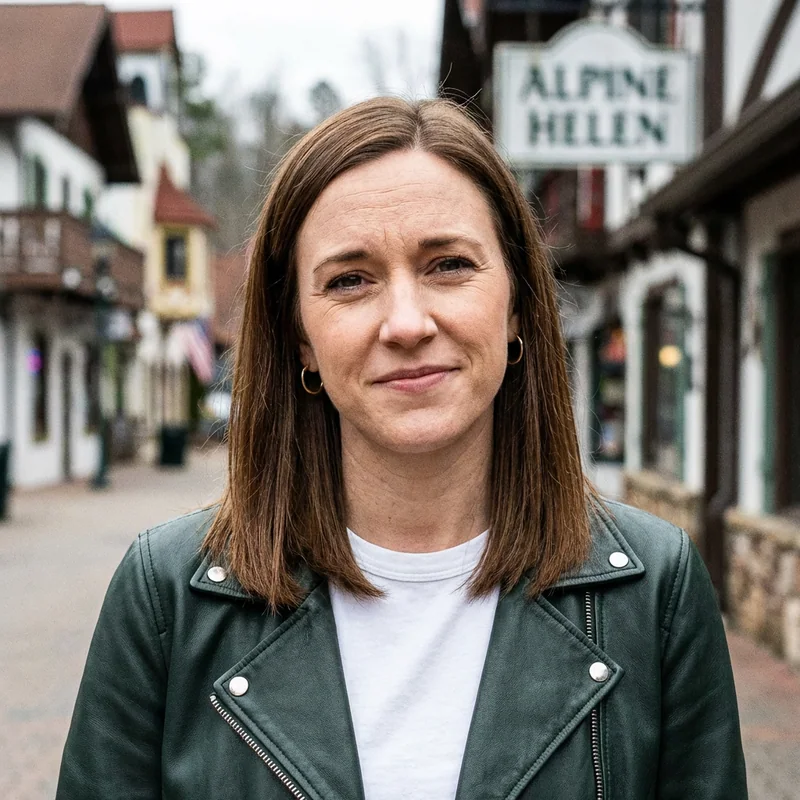
Kaitlyn Reese-Brockman is the Tourism & Hospitality Reporter for Bavarian Brainrot. She has lived in Helen since February 2026 and intends to stay.
— Kaitlyn Reese-Brockman
Reader Comments
Leave a comment ↓